


Things You Need to Know: EPA Unveils Comprehensive PFAS Strategy — Nearly $1 Billion and Standards Water Systems Can Actually Meet
A recap of Monday's announcement and expert panel, where Administrator Zeldin and Secretary Kennedy laid out a full-lifecycle plan to attack PFAS at the source, protect drinking water, and put the Safe Drinking Water Act back on solid legal ground
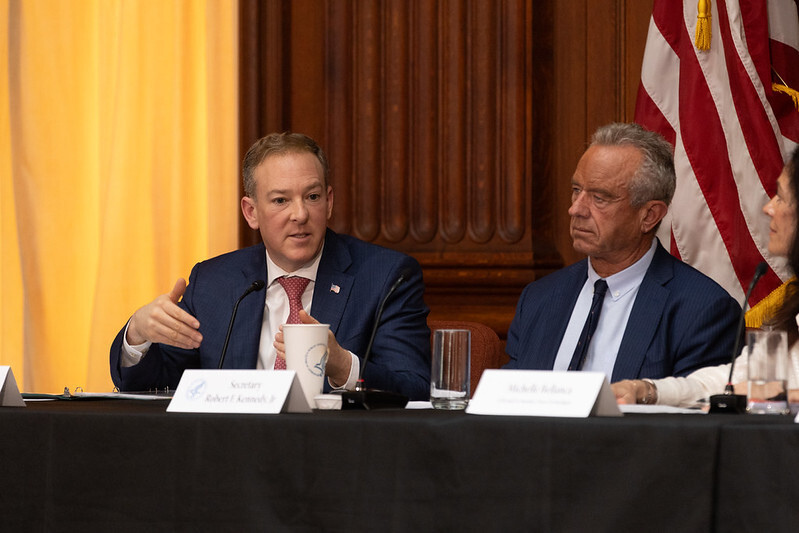
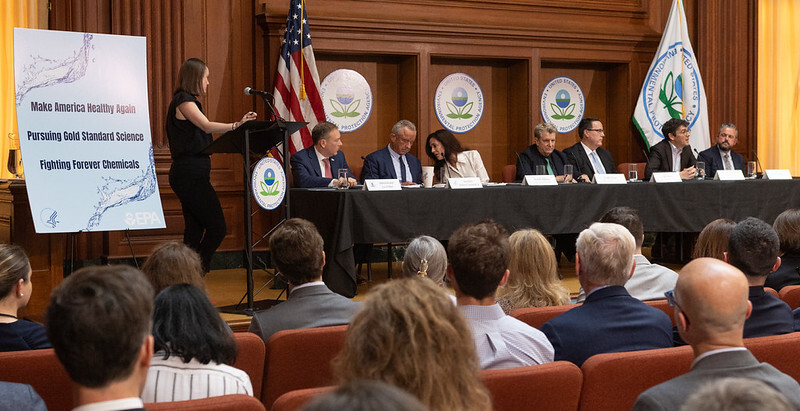
WASHINGTON – At EPA headquarters on Monday, U.S. Environmental Protection Agency (EPA) Administrator Lee Zeldin and U.S. Health and Human Services Secretary Robert F. Kennedy Jr. announced the agency's most comprehensive offensive yet against per- and polyfluoroalkyl substances (PFAS). The event included remarks from Administrator Zeldin, Secretary Kennedy, and EPA Assistant Administrator for Water Jessica Kramer, as well as an expert panel on PFAS destruction technology and rolled out a life-cycle strategy built on three commitments: follow the law, follow the science, and give water systems standards they can build a compliance program around with confidence.
The Announcement at a Glance
Key Takeaways
- The strongest standards stayed in place
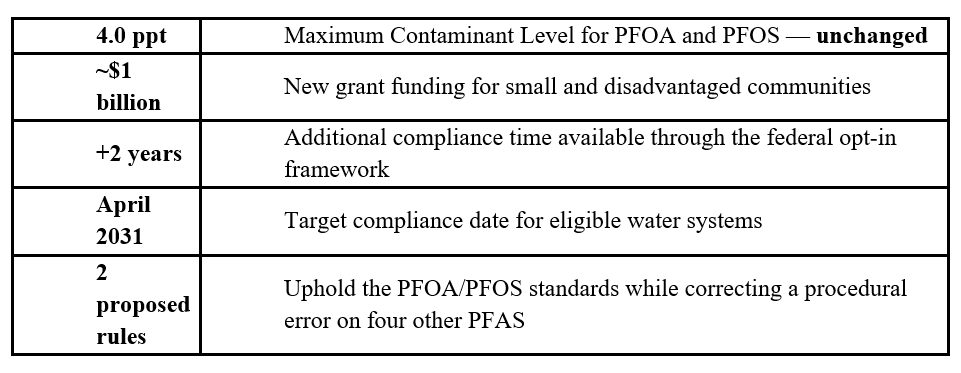
The headline takeaway: the enforceable limits for PFOA and PFOS remain 4.0 parts per trillion each, exactly as set in the 2024 PFAS National Primary Drinking Water Regulation. EPA was clear that the science behind these two chemicals is among the strongest for any contaminant it can regulate — and that all monitoring and reporting deadlines under the April 2024 rule remain in force. The agency framed its work as making the standard workable, not weaker.
- Water systems were given realistic timelines
Officials illustrated how the previous administration's rule set deadlines many water systems simply could not meet — risking costly violations that punish communities without removing a single part per trillion from anyone's tap. EPA's federal exemption framework gives drinking water systems up to two additional years to comply, with a target date of April 2031, in states, territories, and Tribes that have not obtained primacy for those Maximum Contaminant Levels (MCLs).
EPA pointed to three concrete benefits of that extra time:
- Utilities can build the right infrastructure instead of rushing flawed fixes.
- Treatment technology gets cheaper as production scales and innovation matures.
- Ratepayers are protected from rate spikes driven by impossible deadlines.
- Bolstered legal foundation
EPA proposed to rescind the regulations for four additional PFAS — PFHxS, PFNA, HFPO-DA (GenX), and the Hazard Index covering those three plus PFBS — citing how the rule was enacted, not the underlying science. The Safe Drinking Water Act requires a sequential process: propose to regulate, take public comment on whether regulation is warranted, finalize that determination, and only then propose a standard. The agency said the prior administration collapsed those steps, denying the public its required chance to weigh in and leaving the rule legally vulnerable.
EPA stressed this proposal corrects that procedural error and nothing more — and that once the fix is final, the agency will evaluate these PFAS for regulation the right way. EPA cannot predetermine the outcome and noted it is entirely possible the result will be more stringent requirements — but built on a record that holds up.
- The strategy goes upstream, to the source
Rather than asking ratepayers to clean up pollution someone else created, EPA said it is advancing technology-based effluent limits and pretreatment standards for the industrial categories that discharge PFAS — stopping contamination before it reaches a source of drinking water.
- Nearly $1 billion was directed to the communities that need it most
Through the Emerging Contaminants in Small or Disadvantaged Communities Grant, EPA announced nearly $1 billion to help communities address PFAS and other emerging contaminants, with a focus on small and rural systems. That funding is reinforced by hands-on help through EPA's PFAS OUT and RealWaterTA initiatives — free technical assistance, water-quality testing, technical planning, operator training, and funding navigation — so every system, regardless of size, has a realistic path to compliance.
Inside the Expert Panel
Assistant Administrator Kramer led an expert panel on PFAS health threats and the emerging destruction and disposal technologies designed to eliminate these chemicals for good.
Panelists included:
Dave Ross — Executive Vice President, Veolia North America
Barry Shadrix — Global Director, CETCO
Frank Cassou — Chief Executive Officer, Cyclopure
Michelle Bellanca — CEO and Co-Founder, Claros Technologies
Mathias (Matt) Meersseman — U.S. Chief Executive Officer, Desotec
The discussion centered on how destruction technologies can permanently eliminate PFAS rather than simply relocating it.
News coverage and stakeholder conversation surrounding the announcement can be found below:
KRCR: EPA, HHS announces nearly $1B for states to tackle unsafe-levels of PFAS in drinking water
OAN: EPA: $1B in grant funding targeted at combating PFAS or ‘forever chemicals’ in drinking water
Newsmax: EPA Proposes New PFAS Drinking Water Plan
Washington Examiner: EPA and HHS propose rescinding parts of Biden’s PFAS limits in drinking water
WUSF: EPA announces plans to change restrictions on some 'forever chemicals'
NTD: EPA Administrator Lee Zeldin and HHS Secretary RFK Jr. Make Major PFAS Announcement
MAHA Action on X: Lee Zeldin and the EPA are declaring war on forever chemicals....
Additional details about the PFAS announcement can be found here.
Full length footage of the event can be found here.