


Meet EPA Oceanographer Darryl J. Keith Ph.D.
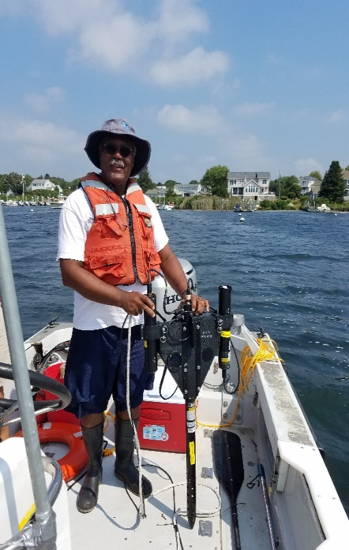
EPA researcher Darryl Keith works with other EPA researchers to provide satellite data products to map the distribution and abundance of seagrass in southern New England estuaries as well as provide water quality information in support of aquaculture farming in two Rhode Island estuaries. Darryl also provides technical assistance to the Rhode Island Department of Environmental Management and Rhode Island Department of Health to monitor the abundance and location of cyanobacteria in lakes and ponds in Rhode Island as well as western Lake Superior through satellite remote sensing.
Tell us about your background.
I received my bachelor’s degree in geology from the University of North Carolina-Chapel Hill. Next, I went to the University of Rhode Island for a masters in geological oceanography and marine policy, followed by a Ph.D. in biological oceanography.
When did you first know you wanted to be a scientist?
Senior year of high school but I always had a very strong interest in science and the oceans.
What do you like most about your research?
Being able to collect data on boats to support research. I also enjoy presenting results to colleagues and interacting with students.
How does your science matter?
Generally, my research uses the power of satellite technology to detect changes in water quality and identify when it’s safe for the public to use waterbodies for recreation and daily use and consumption. Observing changes in water quality across multiple locations and during various times can be difficult. Changes, such as events like toxic harmful algal blooms, may go undetected and result in environmental and human health issues.
Using this technology for environmental monitoring reduces societal costs such as illness, missed days of work, or decreased recreational opportunities. In addition, my science provides information for more places and more times than has been possible in the past and will reduce the financial burden of state agencies to conduct their missions.
If you weren’t a scientist, what would you be doing?
I would be a high school science teacher
What advice would you give a student interested in a career in science?
Pursue internships and summer employment opportunities in your area of interest. Develop contacts and network in your area of interest as well.
What’s your role in space research at EPA?
I primarily apply satellite data to monitor cyanobacteria and general water quality conditions of freshwater bodies in terrestrial environments. I also monitor phytoplankton, nutrient dynamics, and general coastal water quality using data from the International Space Station and other earth-orbiting satellites.
What do you think the coolest scientific discovery was and why?
Launching the James Webb telescope and seeing the beautiful, detailed images from the cosmos. These and future images will expand our view and understanding of the universe.
If you could have dinner with any scientist, past or present, who would you choose and what would you talk about?
Robert Ballard. The conversation would not only revolve around his discoveries of ancient and recent shipwrecks and their places in history using remotely operated vehicles (ROVs) but the significance of the technologies that he pioneered to make these discoveries possible.
What do you think is our biggest scientific challenge in the next 20/50/100 years?
Mitigating the effects of global warming through innovation and social change.
Editor's Note: The opinions expressed herein are those of the researcher alone. EPA does not endorse the opinions or positions expressed.