


Hot Topics in Alaska
Learn about some of EPA's priority work in Alaska.
Alaska hazardous waste program authorization
EPA has reviewed Alaska’s application for authorization of its hazardous waste program and determined that it meets all of the statutory and regulatory requirements established under the Resource Conservation and Recovery Act. Therefore, EPA has granted Alaska final authorization to operate its hazardous waste program, subject to the authority retained by EPA under RCRA, effective immediately.
Section 3006 of RCRA allows EPA to authorize state hazardous waste programs to operate in the state in lieu of the federal hazardous waste management program. EPA grants authorization if the agency finds that the state program:
- Is “equivalent” to the federal program.
- Is consistent with the federal program and other state programs.
- Provides for adequate enforcement (Section 3006(b), 42 U.S.C. 6926(b)(pdf)).
State programs must be at least as stringent as the federal program. EPA regulations for final state authorization appear at 40 CFR part 271.
EPA received four written comments during the public comment period from May 14 through July 2, 2026. Significant issues raised by the commenters and EPA's responses are summarized in the final authorization published in the Federal Register on August 6, 2026.
For more information:
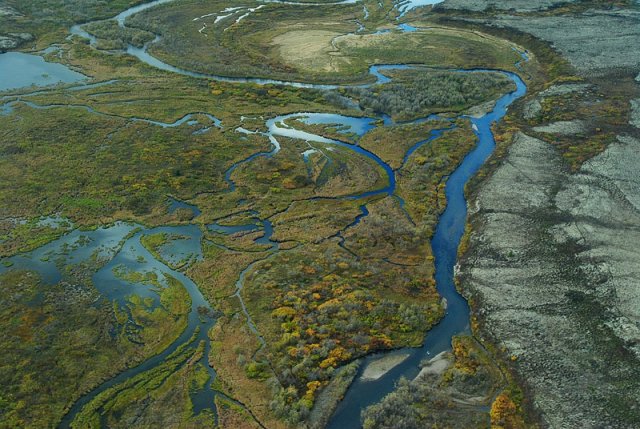
Bristol Bay
EPA's Final Determination limits the disposal of dredged and fill material associated with developing the Pebble deposit in certain waters that are important to sustaining the region’s salmon resources.
- Learn more about EPA's efforts to protect the Bristol Bay watershed.
Alaska Native Claims Settlement Act lands
The Alaska Native Claims Settlement Act of 1971 included the transfer of 44 million acres to Alaska Native regional and village corporations. Some of these lands became contaminated prior to the conveyance (transfer) from a variety of past activities such as fuel storage, power generation, waste handling practices, mining and other activities.
- Learn more about contamination on ANCSA conveyed lands.
Fairbanks air quality
EPA is working with state and local officials to address deficiencies in Alaska's nonattainment plan to ensure the area reaches attainment of air quality standards for fine particulate matter (PM2.5).
- Learn more about the Fairbanks Air Quality Plan.
Transboundary mining pollution
Eight organizations will receive $1,749,700 through EPA’s Transboundary Watershed Grant Program to monitor and reduce transboundary mining pollution in U.S.-British Columbia transboundary watersheds, including:
- Central Council of the Tlingit and Haida Indian Tribes of Alaska.
- Ketchikan Indian Community.
- Alaska Department of Fish and Game.
Read EPA's grant awards announcement.
Arctic Council
The Arctic Council, established in 1996, is a high level international forum that promotes cooperation among Arctic nations on sustainable development and environmental protection. As the Arctic environment changes, leading to increased shipping, economic, and other activities, it becomes increasingly important that the U.S. work closely with our Arctic allies.
- Learn more about EPA's role in the Arctic Council.
Superfund
Eielson Air Force Base
The U.S. Air Force is the lead agency for cleaning up contamination at the site from historical military operations – in coordination with EPA and the Alaska Department of Environmental Conservation. The site is located about 24 miles southeast of Fairbanks. It was added to EPA's Superfund cleanup list in 1989.
- Learn more about the Eielson Air Force Base Superfund cleanup.
Joint Base Elmendorf-Richardson
The U.S. Air Force is the lead agency for cleaning up contamination at the site from historical military operations – in coordination with EPA and the Alaska Department of Environmental Conservation. The site is located in Anchorage. It was added to EPA's Superfund cleanup list in 1990.
- Learn more about the Joint Base Elmendorf-Richardson Superfund cleanup.
Salt Chuck Mine
The Salt Chuck Mine is an inactive former gold, silver, copper, and palladium mine on Prince of Wales Island in the Tongass National Forest in southeast Alaska. This site was added to EPA's Superfund cleanup list in 2010.
- Learn more about the Salt Chuck Mine Superfund cleanup.
Find more Superfund sites in Alaska.
Tribal programs
EPA's Region 10 office serves 271 federally recognized Tribes, including 229 Tribes in Alaska.
- Learn more about EPA Region 10's Tribal programs.