


Clean Water State Revolving Fund Emerging Contaminants
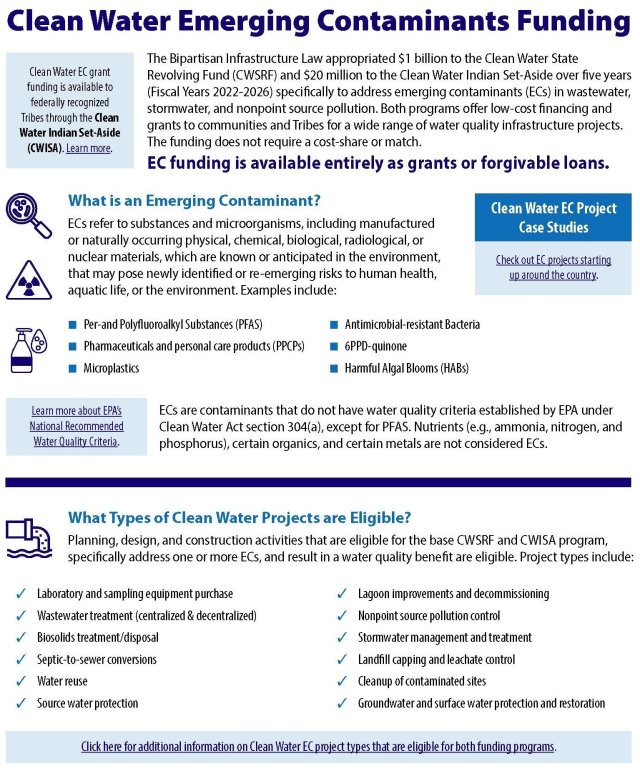
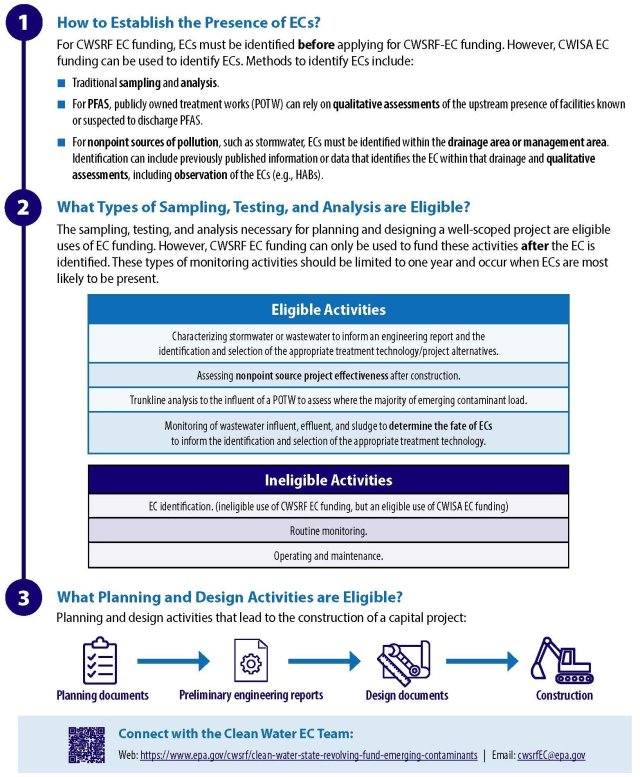
The Infrastructure Investment and Jobs Act appropriates $1 billion over five years (FY 2022 to FY 2026) to the Clean Water State Revolving Fund specifically to address emerging contaminants, including perfluoroalkyl and polyfluoroalkyl substances (PFAS) in wastewater, stormwater, and nonpoint source pollution.
On this page:
Fact Sheets and Reports
Scroll down to view the fact sheet online.
-
Characteristics and Treatment of Pharmaceuticals and Personal Care Products in Wastewater (pdf)
This technology brief provides preliminary information on treating pharmaceuticals and personal care products (PPCPs) in municipal wastewater to inform the initial identification of PPCP treatment technology. PPCPs are a varied group of chemicals derived from medications, lotions, soaps, and other personal care products. This brief discusses the characteristics of PPCPs that make them resistant to removal in conventional wastewater treatment facilities and a review of known treatment options.
-
2024 Municipal Wastewater PFAS Removal Technologies Research Workshop: Proceedings Report (pdf)
Appendix D. PFAS Removal Technologies Workshop Presentations (pdf)
To support the development of innovative technologies as well as implementation of CWSRF Emerging Contaminants funds provided by the Infrastructure Investment and Jobs Act (P.L. 117-58), EPA partnered with the Water Research Foundation, Interstate Technology and Regulatory Council, Water Environment Federation, and leading researchers to conduct a workshop on promising innovative technologies for PFAS removal from municipal wastewater. The workshop focused on research results and R&D needs among several technologies under development. Researchers provided presentations and input regarding technologies’ performance data, implementation considerations, and remaining research to advance technologies towards full scale.
Eligibility Decision Tree
The CWSRF Emerging Contaminants Project Eligibility Decision Tool (pdf) is a screening method to assess if a project or an applicant is eligible to use these funds. Eligible applicants and borrowers may vary by state. Contact the CWSRF contact for your state to learn about eligibilities in your state.
Case Studies of CWSRF-Eligible Emerging Contaminants Projects
- City of Tucson (Arizona) Water Department Reclaimed Water Emerging Contaminants Project (pdf)
- City of Orlando (Florida) Water Reclamation Division Technology Pilot of PFAS Destruction in Biosolids (pdf)
- Fort Wayne City Utilities (Indiana): Fort Wayne Water Pollution Control Plant PFAS Monitoring, Laboratory Upgrades and Technology Pilot (pdf)
- City of Cedar Rapids (Iowa) Water Pollution Control Facility Emerging Contaminants Project (pdf)
- City of Belding (Michigan) Wastewater Treatment Plant Lagoon Decommissioning and Sludge Disposal (pdf) (pdf)
- Montana Department of Public Health and Human Services Laboratory Equipment Purchase (pdf)
- Southern Nevada Septic-to-Sewer Conversion Emerging Contaminants Project (pdf)
- Town of Conway (New Hampshire) Landfill Leachate Treatment Emerging Contaminants Project (pdf)
- New York State's Solicitation Process Source Water Protection Planning Projects (pdf)
- Metropolitan Sewer District of Greater Cincinnati, Ohio Reducing Antimicrobial Resistance from Hospital Wastewater (pdf)
- Central Oklahoma Master Conservancy District Lake Thunderbird Emerging Contaminants Assessment Project (pdf)
- City of Norman, Oklahoma Water Reclamation Facility Land Application of Biosolids and Yard Waste Compost Demonstration Project (pdf)
- City of Seattle (Washington) Public Utilities South Thornton Natural Drainage System Installation (pdf)
Frequent Questions
- Scroll through an online version of the Frequent Questions to assist states in developing their application for Infrastructure Investment and Jobs Act capitalization grants for the CWSRF emerging contaminants funding.