


National Enforcement and Compliance Initiative: Chemical Accident Risk Reduction
Launched in Fiscal Year (FY) 2017, the Chemical Accident Risk Reduction National Enforcement Compliance Initiative (NECI) seeks to reduce risks to human health and the environment by decreasing the likelihood of chemical accidents. Thousands of facilities nationwide make, use, or store extremely hazardous substances. Clean Air Act (CAA) section 112(r) requires such facilities to implement programs to manage risks posed by their operations. Failure to do so can result in catastrophic accidents that cause serious injuries and fatalities, evacuations, and shelter-in-place orders. Major chemical accidents continue to occur at facilities that are not adequately managing risk. It is critical to address the significant CAA section 112(r) non-compliance observed throughout the country to ensure the safety of workers, first responders, and the American public.
The accident risk reduction activities conducted under this NECI are based on three legal authorities. Most of the activities are based on CAA section 112(r) Risk Management Program and General Duty Clause requirements. Additional activities are based on requirements under the Emergency Planning and Community Right-to-Know Act and Comprehensive Environmental Response, Compensation, and Liability Act.
Goals
- Inspect and address identified violations at high-risk facilities.
- Continue to develop credentialed inspectors nationwide.
- Criminally investigate violations as warranted, particularly where there is significant harm and culpable conduct.
FY 2025 Results
Compliance Monitoring Activities
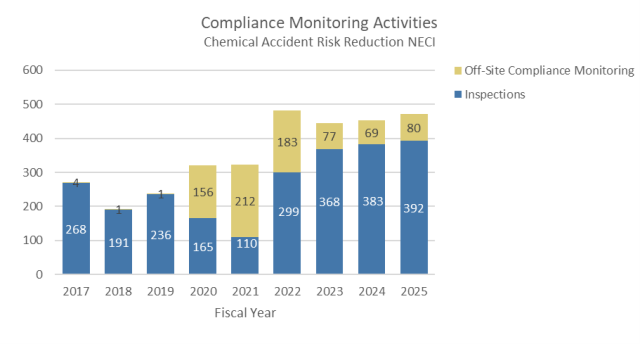
In FY 2025, the U.S. Environmental Protection Agency (EPA) completed a total of 472 compliance monitoring activities under this initiative.
The graphic below displays compliance monitoring activities for the three cycles of the NECI from FY 2017 through FY 2025.
Enforcement Cases
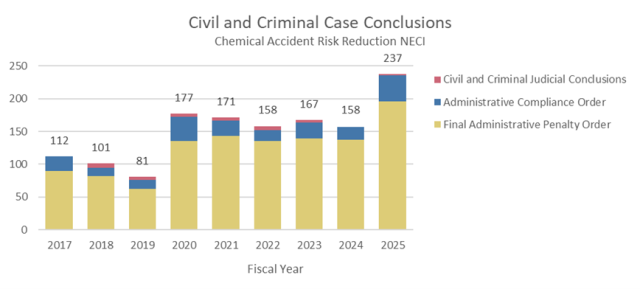
In FY 2025, EPA finalized 237 enforcement cases to decrease the likelihood of chemical accidents.
The graphic below displays civil and criminal case conclusions for the three cycles of the NECI from FY 2017 through FY 2025.
In addition, the agency continued to develop credentialed inspectors through updated training, including Process Hazard Analysis, Mechanical Integrity, and Risk Management Program Inspector training. EPA increased collaboration between its civil and criminal enforcement programs and with other agencies, including the Occupational Safety and Health Administration and the Chemical Safety Board.