U.S. flag

An official website of the United States government

Here’s how you know

Dot gov

Official websites use .gov
A .gov website belongs to an official government organization in the United States.

HTTPS

Secure .gov websites use HTTPS
A lock (LockA locked padlock) or https:// means you’ve safely connected to the .gov website. Share sensitive information only on official, secure websites.

    • Environmental Topics
    • Air
    • Bed Bugs
    • Chemicals, Toxics, and Pesticide
    • Emergency Response
    • Environmental Information by Location
    • Health
    • Land, Waste, and Cleanup
    • Lead
    • Mold
    • Radon
    • Research
    • Science Topics
    • Water Topics
    • A-Z Topic Index
    • Laws & Regulations
    • By Business Sector
    • By Topic
    • Compliance
    • Enforcement
    • Guidance
    • Laws and Executive Orders
    • Regulations
    • Report a Violation
    • Environmental Violations
    • Fraud, Waste or Abuse
    • About EPA
    • Our Mission and What We Do
    • Headquarters Offices
    • Regional Offices
    • Labs and Research Centers
    • Newsroom
    • Planning, Budget, and Results
    • Organization Chart
    • EPA History

Breadcrumb

  1. Home
  2. Great Lakes Monitoring

Great Lakes Sediment Surveillance Program

EPA’s Great Lakes Sediment Surveillance Program (GLSSP) was initiated in 2010 to monitor the spatial distribution and temporal trends of persistent, bioaccumulative, and/or toxic chemicals in bottom sediments of the Great Lakes. These contaminants enter the lakes through various pathways and can attach onto particles that sink down to the sediments at the bottom of the lake and enter the food web, posing risks to aquatic life. This program helps EPA meet obligations under Section 118(c)(1)(B) of the Clean Water Act to establish a Great Lakes system-wide surveillance network to monitor the water quality of the Great Lakes with a specific emphasis on the monitoring of toxic pollutants. 

Background and Objectives 

This program collects and analyzes sediment contaminants in all five Great Lakes. Sediment surface samples are collected via a box corer and analyzed to monitor spatial distribution of surface sediment contaminants within the Great Lakes. Sediment core samples (100 cm long) are collected at a subset of sites via a multi-corer and are dated using radiometric dating techniques to determine the age of sediment layers within the core samples, with more recent sediment at the top and older sediment at the bottom. Analyzing the concentration of contaminants at different depths in the core reveals a timeline of contaminant trends over many decades. The United States Geological Survey Upper Midwest Water Science Center Mercury Research Laboratory performs mercury analysis for GLSSP samples.


Two scientists collecting sediment while on a ship.
The multi-corer is used to collect sediment core samples aboard the R/V Lake Guardian.
The box corer is used to collect sediment surface samples aboard the R/V Lake Guardian.
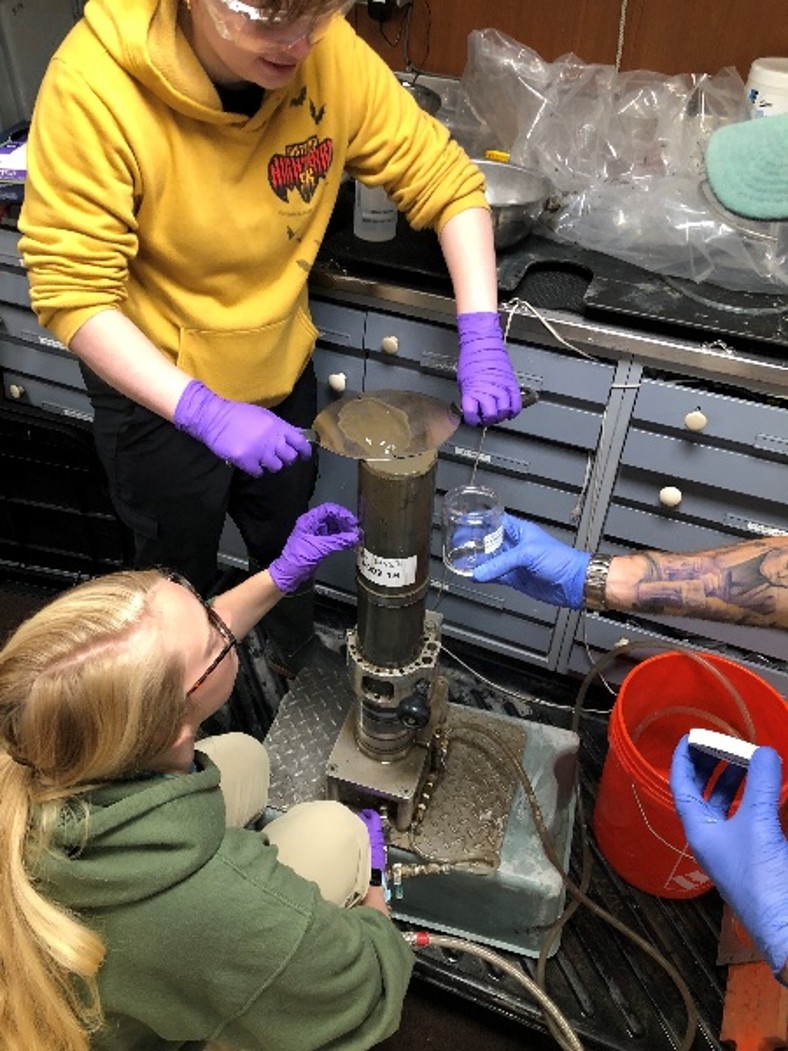
Scientists process a sediment core in the R/V Lake Guardian wet laboratory using a hydraulic extruder. Sediment layers are gently pushed up and out of the core tube for sediment dating and contaminant analysis in laboratories on shore.
Scientists process a sediment core in the R/V Lake Guardian wet laboratory using a hydraulic extruder. Sediment layers are gently pushed up and out of the core tube for sediment dating and contaminant analysis in laboratories on shore. 

Monitoring Locations

The GLSSP monitors more than 250 contaminants in sediment at 157 sites within the Great Lakes. These sites are focused in deep, offshore areas within the lakes and in areas downstream of 21 tributary mouths. Sediment collected from these depositional areas is analysed to monitor amounts and types of sediment contaminants in the Great Lakes. 
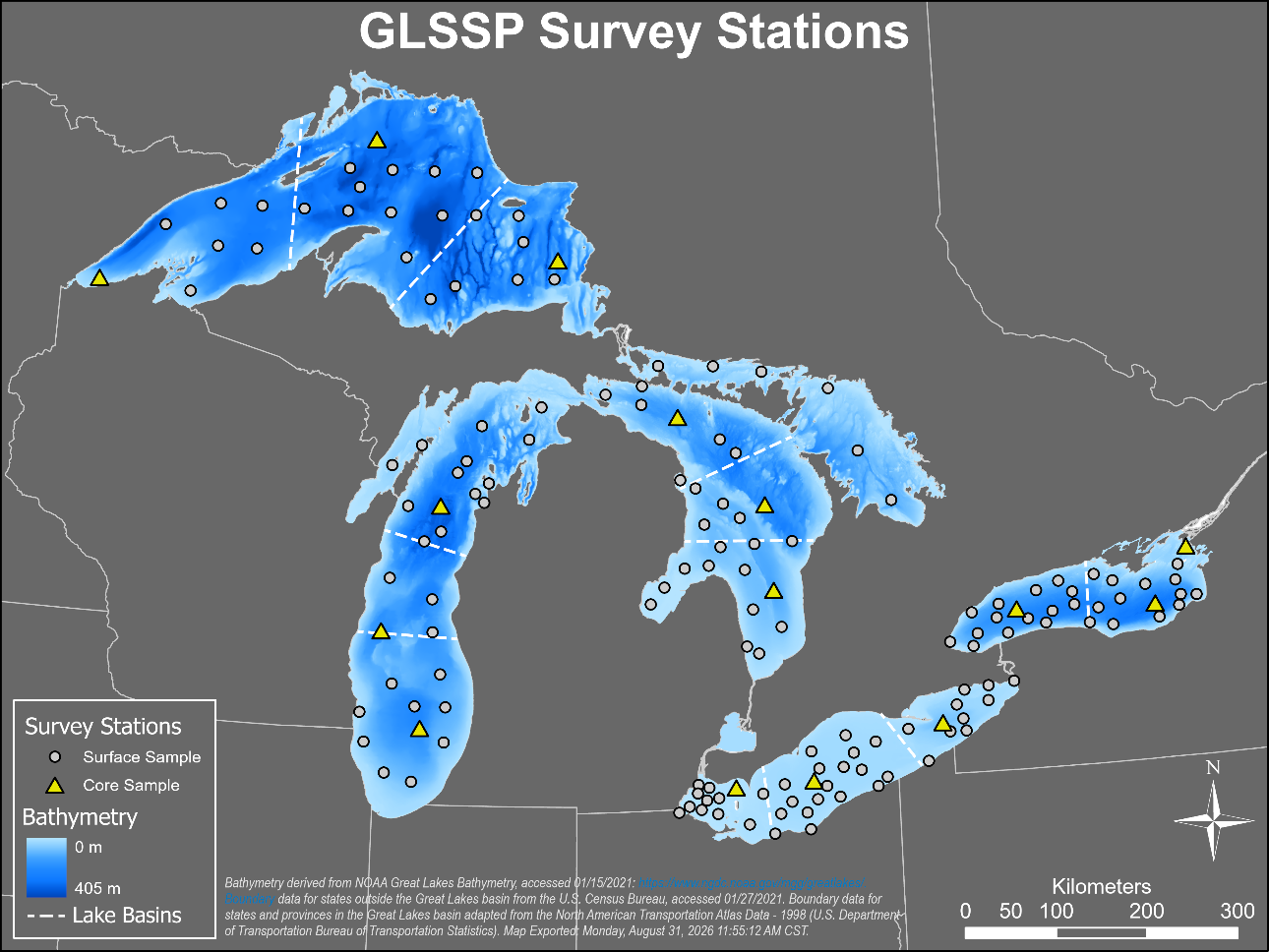
Map depicting survey station locations in the Great Lakes.
GLSSP Survey Stations 2021-2025. 

Data and Trends

GLSSP sediment core data show that concentrations of PCBs and OCPs in Great Lakes sediments have decreased since the 1970s, when they were phased out of production. In general, higher concentrations of legacy contaminants have been observed near more urbanized areas within the Great Lakes. GLSSP data are available via the Great Lakes Environmental Database on the EPA Central Data Exchange.

Contact Information

Brian Lenell
(lenell.brian@epa.gov)
312-353-4891

Monitored Contaminants

  • (PCBs)
  • Mercury
  • Per- and polyfluoroalkyl substances (PFAS) 
  • Polychlorinated dibenzodioxins (PCDDs) and polychlorinated dibenzofurans (PCDFs)
  • Organochlorine pesticides (OCPs)
  • Polybrominated diphenyl ethers (PBDEs) 
  • Organophosphate esters (OPEs) 
  • Polycyclic aromatic hydrocarbons (PAHs) 
  • Polychlorinated naphthalene (PCNs) 
  • Polychlorinated diphenyl ethers (PCDEs) 
  • Polyhalogenated carbazoles (PHCZs) 
  • Synthetic musk fragrances (MFs) 
  • Non-PBDE brominated flame retardants and Non-Dechlorane Plus (DP) chlorinated flame retardants 
  • Triazine herbicides 
  • Metals 

Great Lakes Monitoring

  • Great Lakes Monitoring
    • Great Lakes Water Quality Monitoring Program
    • Integrated Atmospheric Deposition Network
    • Great Lakes Biology Monitoring Program
    • Great Lakes Fish Monitoring and Surveillance Program
  • EPA's Research Vessel Lake Guardian
  • Great Lakes Coastal Wetland Monitoring Program
    • Why Monitoring of the Great Lakes Coastal Wetlands is Important
    • How the Great Lakes Coastal Wetlands are Monitored
    • Where Great Lakes Coastal Wetlands Occur
    • Great Lakes CWMP Results and Major Findings
    • How the CWMP Data are Being Used
Contact Us About Great Lakes Monitoring
Contact Us About Great Lakes Monitoring to ask a question, provide feedback, or report a problem.
Last updated on October 28, 2026
  • Assistance
  • Spanish
  • Arabic
  • Chinese (simplified)
  • Chinese (traditional)
  • French
  • Haitian Creole
  • Korean
  • Portuguese
  • Russian
  • Tagalog
  • Vietnamese
United States Environmental Protection Agency

Discover.

  • Accessibility Statement
  • Budget & Performance
  • Contracting
  • EPA www Web Snapshot
  • Grants
  • No FEAR Act Data
  • Plain Writing
  • Privacy and Security Notice

Connect.

  • Data
  • Inspector General
  • Jobs
  • Newsroom
  • Regulations.gov
  • Subscribe
  • USA.gov
  • White House

Ask.

  • Contact EPA
  • EPA Disclaimers
  • Hotlines
  • FOIA Requests
  • Frequent Questions
  • Site Feedback

Follow.