


Learn about Polychlorinated Biphenyls
On this page:
- What Are PCBs?
- Commercial Uses for PCBs
- Release and Exposure of PCBs
- PCB Congeners
- PCB Homologs
- PCB Mixtures and Trade Names
- Health Effects of PCBs
- Laws and Regulations
- Changes to the Manifest Regulations
What Are PCBs?
Polychlorinated biphenyls, or PCBs, are a group of man-made organic chemicals consisting of carbon, hydrogen and chlorine atoms. The number of chlorine atoms and their location in a PCB molecule determine many of its physical and chemical properties. PCBs have no known taste or smell, and range in consistency from thin, light-colored liquids to yellow or black waxy solids.
PCBs were domestically manufactured from 1929 until their manufacturing and importation was banned in the U.S. in 1979 based on mounting evidence that they were toxic to human health and the environment. Due to their non-flammability, chemical stability, high boiling point and electrical insulating properties, PCBs were used in hundreds of industrial and commercial applications including:
- Electrical, heat transfer and hydraulic equipment.
- Plasticizers in paints, plastics and rubber products.
- Pigments, dyes and carbonless copy paper.
- Other industrial applications.
Commercial Uses for PCBs
Although no longer commercially produced in the United States, PCBs may be present in products and materials produced before the 1979 PCB ban. Products that may contain PCBs include:
- Transformers and capacitors.
- Electrical equipment including voltage regulators, switches, re-closers, bushings, and electromagnets.
- Oil used in motors and hydraulic systems.
- Old electrical devices or appliances containing PCB capacitors.
- Fluorescent light ballasts.
- Cable insulation.
- Thermal insulation material including fiberglass, felt, foam, and cork.
- Adhesives and tapes.
- Oil-based paint.
- Caulking.
- Plastics.
- Carbonless copy paper.
- Floor finish.
The PCBs used in these products were chemical mixtures made up of a variety of individual chlorinated biphenyl components known as congeners. Most commercial PCB mixtures are known in the United States by their industrial trade names, the most common being Aroclor.
Release and Exposure of PCBs
Today, PCBs can still be released into the environment from:
- Poorly maintained hazardous waste sites that contain PCBs.
- Illegal or improper dumping of PCB wastes.
- Leaks or releases from electrical transformers containing PCBs.
- Improper disposal of PCB-containing consumer products into landfills not designed to handle hazardous waste.
- Burning some wastes in municipal and industrial incinerators.
PCBs do not readily break down once in the environment and can remain for long periods cycling between air, water and soil. They also can be carried long distances and have been found in snow and sea water in areas far from where they were released into the environment. As a consequence, they are found all over the world.
PCBs can accumulate in plants including food crops and be taken up into the bodies of other organisms. For example, people who ingest fish may be exposed to PCBs that have bioaccumulated in the fish they are ingesting.
The National Center for Health Statistics, a division of the Centers for Disease Control and Prevention, conducts the National Health and Nutrition Examination Surveys. NHANES is a series of U.S. national surveys on the health and nutrition status of the noninstitutionalized civilian population, which includes data collection on selected chemicals. Interviews and physical examinations are conducted with approximately 10,000 people in each two-year survey cycle. PCBs are one of the chemicals for which data are available from the NHANES surveys.
PCB Congeners
A PCB congener is defined as a single molecule that consists of a biphenyl ring with one to ten chlorine atoms attached to it resulting in a total of 209 possible combinations. The name of a congener specifies the total number of chlorine substituents, and the position of each chlorine. For example: 4,4'-Dichlorobiphenyl is a congener comprising the biphenyl structure with two chlorine substituents - one on each of the #4 carbons of the two phenyl rings.
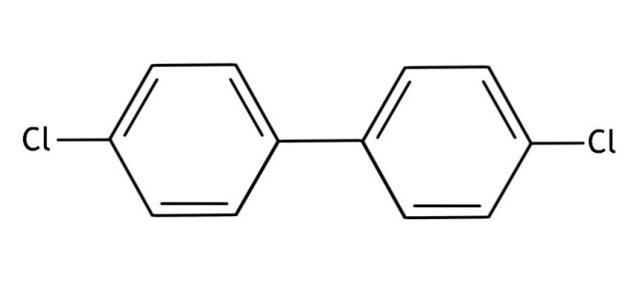
In 1980, a numbering system was developed which assigned a sequential number to each of the 209 PCB congeners.
PCB Homologs
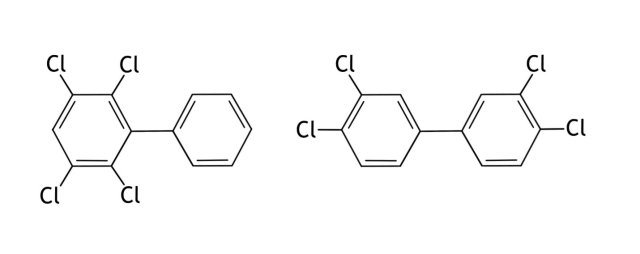
Homologs are subcategories of PCB congeners that have the same numbers of chlorine substituents. For example, the tetrachlorobiphenyls are all PCB congeners with exactly 4 chlorine substituents that can be in any arrangement.
PCB Mixtures and Trade Names
With few exceptions, PCBs were manufactured as a mixture of individual PCB congeners. These mixtures were created by adding progressively more chlorine to batches of biphenyl until a certain target percentage of chlorine by weight was achieved. Commercial mixtures with higher percentages of chlorine contained higher proportions of the more heavily chlorinated congeners, but all congeners could be expected to be present at some level in all mixtures. While PCBs were manufactured and sold under many names, the most common was the Aroclor series.
Aroclor
Aroclor is a PCB mixture produced from approximately 1930 to 1979. It is one of the most commonly known trade names for PCB mixtures. There are many types of Aroclors and each has a distinguishing suffix number that indicates the degree of chlorination. The numbering standard for the different Aroclors is as follows:
- The first two digits usually refer to the number of carbon atoms in the phenyl rings (for PCBs this is 12).
- The second two numbers indicate the percentage of chlorine by mass in the mixture. For example, the name Aroclor 1254 means that the mixture contains approximately 54% chlorine by weight.
PCB Trade Names
PCBs were manufactured and sold under many different names. Many of these names were used with distinguishing suffixes, indicating degree of chlorination, type of formulation, or other properties (e.g., Aroclor 1254; Clophen A60). Refer to the link below for a comprehensive list of the PCB Trade Names. Please note that some of these names may be used for substances or mixtures not containing PCBs, and some of these names may be misspellings of the correct names but are included in the list for completeness.
Health Effects of PCBs
PCBs have been demonstrated to cause a variety of adverse health effects in animal and humans. Learn more about health effects of PCBs.
Laws and Regulations
Statute: Toxic Substances Control Act
The Toxic Substances Control Act of 1976 provides EPA with authority to require reporting, record-keeping and testing requirements, and restrictions relating to chemical substances and/or mixtures, including PCBs. Some substances are generally excluded from TSCA, including but not limited to, food, drugs, cosmetics and pesticides. TSCA addresses the production, importation, use and disposal of specific chemicals including polychlorinated biphenyls, asbestos, radon and lead-based paint.
Summary of the Toxic Substance Control Act.
Inadvertent PCBs
Though PCB production was banned in 1979 by the Toxic Substances Control Act, EPA’s regulations implementing TSCA for PCBs allow some inadvertent generation of PCBs to occur in excluded manufacturing processes, as defined in title 40 of the Code of Federal Regulations section 761.3.
Specifically, the PCB regulations allow inadvertently generated PCBs at defined concentrations, under certain conditions, and with requirements to report to EPA and maintain certain records. Learn more about iPCBs, including the regulatory context, EPA enforcement, iPCBs in the environment, ongoing research conducted by EPA, and pollution prevention efforts.
PCB Regulations: Part 761 in Title 40 of the Code of Federal Regulations
Current PCB regulations, published pursuant to the TSCA statute, can be found in Title 40 of the Code of Federal Regulations in Part 761. The Government Printing Office maintains the most current version of the CFR (view PCB regulations in the electronic-CFR). For useful interpretation of the regulations as well as answers to frequently asked questions please visit EPA's Policy and Guidance for PCBs webpage.
Detailed List of PCB Federal Register Notices (As of July 2, 2024)
EPA publishes information about the PCB program through the Federal Register. The Federal Register Notices listed in the Detailed List of Federal Register Notices webpage include PCB-related rules (proposed and final), notices of public meetings, responses to official comments, etc. This is not a comprehensive list of current regulations. A searchable listing of EPA's Register Notices can be found on the Federal Digital System webpage.
PCBs and Hazardous Waste
PCBs are not defined as hazardous wastes (Memo, Weddle to Verde; May 18, 1984 - RCRA Online Number 12235 (pdf)(39.3 KB)). However, it is possible that PCBs may be incidental contaminants in listed hazardous waste (e.g., solvent used to remove PCBs from transformers) or may be present in wastes that are characteristically hazardous. In these cases, wastes that otherwise meet a listing criteria or are characteristically hazardous are still subject to RCRA regulation regardless of PCB content.
However, to avoid duplicative regulation with Toxic Substances Control Act, certain PCB-containing wastes that exhibit the toxicity characteristic are exempt from regulation under RCRA (Monthly Call Center Report Question; September 1996 - RCRA Online Number 14014 (pdf)(32.7 KB)). 40 CFR section 261.8 exempts from RCRA Subtitle C regulation PCB-containing dielectric fluid and the electric equipment which holds such fluid if they satisfy two criteria. First, these PCB wastes must be regulated under the TSCA standards of Part 761. Second, only the PCB wastes which exhibit the toxicity characteristic for an organic constituent (waste codes D018-43) may qualify for the exemption (40 CFR section 261.8).
States may also have a regulatory program which is more stringent or broader in scope than the Federal program. Many states have expanded their universe of regulated wastes to cover additional wastes (e.g., PCBs) not defined as hazardous under the Federal program. Individuals should check with their state to see if they are subject to any state requirements.
Additional information regarding the regulation of PCBs under RCRA is available in the following guidance documents:
- Memo, Lowrance to Wassersug; September 22, 1989 - RCRA Online Number 11470 (pdf)(33.5 KB).
- Memo, Porter to McCloskey; April 26, 1986 - RCRA Online Number 11144 (pdf)(9.7 KB)).
Changes to the Manifest Regulations
On July 26, 2024, EPA published the Integrating e-Manifest With Hazardous Waste Exports and Other Manifest-Related Reports, PCB Manifest Amendments, and Technical Corrections Final Rule. This rule amends certain aspects of the manifest regulations for shipments of hazardous waste and polychlorinated biphenyls that are transported for treatment, storage, and disposal. On October 31, 2024, EPA published four minor corrections to this rule.
- Federal Register: Final Rule – July 26, 2024.
- Federal register: Correction – October 31, 2024.
The docket ID number for this rulemaking is EPA-HQ-OLEM-2021-0609 and can be accessed at Regulations.gov.
For more information about Manifesting regulations and protocols on the PCB Program, please visit the Frequent Questions about e-Manifest webpage.