


Waste Isolation Pilot Plant (WIPP) in Carlsbad, New Mexico
On this page:
Facility Description
Waste Isolation Pilot Plant (WIPP) is the United States’ deep geologic repository for defense-generated transuranic (TRU) radioactive waste, located approximately 25-mile East of Carlsbad, New Mexico, and operated by the U.S. Department of Energy (DOE). The WIPPs mission is to permanently dispose (2,150 feet underground) of defense TRU waste - materials contaminated with manmade, long-lived radionuclides (primarily plutonium) from nuclear weapons production and related research. Its disposal approach, salt creep backfilling and long-term isolation, provides passive, geologic containment without ongoing active systems. WIPP has received and emplaced waste since March 1999, from thirteen Department of Energy (DOE) sites across the country.
Facility Layout
The Waste Isolation Pilot Plant (WIPP) permanently isolates defense-generated transuranic (TRU) waste 2,150 feet below the surface in an
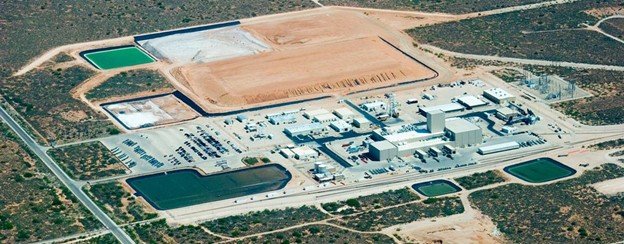
ancient salt formation. Large disposal panels are mined out, with each panel consisting of seven rooms. The rooms are 13-feet high, 33-feet wide and 300-feet long, with a 100-foot beam of salt separating each room. The configuration of the repository has eight panels, with four on each side of the main access drifts. Two additional panels are planned. There are four main access drifts used to transport waste to the panels and for ventilation. Once a panel is filled, it is closed, which includes steel bulkheads.
Panels are not mined until right before they are needed for waste emplacement due to the natural movement of salt, which begins to close the opening within a relatively short period of time. It is this property of salt that led to the selection of a salt bed for the WIPP repository, as over time, the salt will completely encapsulate the waste, safely isolating it from the environment. In active portions of the mine, ground control is needed to maintain mined openings. Ground control includes the installation and maintenance of long steel bolts and wire mesh into the roof and walls.
The underground is accessed using one of four vertical shafts. The largest shaft, with a 20-foot diameter, is used to transport employees, equipment and TRU waste to the underground. The waste hoist has a 45-ton capacity and is capable of transporting 75 employees at one time. Access can also be made using the 10-foot diameter salt shaft. The salt hoist is capable of transporting up to 15 employees, however, is primarily used for taking eight tons of salt at a time out of the underground for storage on the surface. The final two shafts are air intake, which brings air into the underground, and exhaust, where air exits.
Summary of PCB Operations
The Facility is approved to store and dispose of PCB‑contaminated transuranic (TRU) waste and TRU waste that is also hazardous (“TRU mixed waste”), including PCB remediation waste, PCB Articles, and PCB bulk product waste. For this approval, both PCB/TRU and PCB/TRU mixed waste are treated as “PCB Items” per 40 CFR § 761.3. “TRU waste” is defined by the Facility as waste containing more than 100 nanocuries per gram of alpha‑emitting transuranic isotopes with half‑lives greater than 20 years, excluding high‑level radioactive waste, waste that DOE (with EPA concurrence) has determined does not require deep isolation, and waste the NRC has approved for disposal under 10 CFR Part 61. “TRU mixed waste” is TRU waste that also meets the hazardous waste definition under the Hazardous Waste Act and 20 NMAC 20.4.1.200 (incorporating 40 CFR § 261.3). The term “PCB/TRU waste” refers to both categories.
Operationally, TRU waste is classified as contact‑handled (CH) when its surface dose rate is no greater than 200 millirem per hour, and remote‑handled (RH) when the surface dose rate is 200 millirem per hour or higher. Disposal of free‑flowing PCB liquids is prohibited at the Facility; only incidental liquids (e.g., rainwater, groundwater, condensate, leachate, load‑separation fluids, and dust‑control water) are permitted in PCB/TRU and PCB/TRU mixed bulk product waste containers, and only up to 1 percent of the container volume. Additionally, the Facility may not receive ignitable waste as defined in 40 CFR § 261.21.
Documents
Polychlorinated Biphenyls (PCBs) Factsheet (pdf)
Polychlorinated Biphenyls (PCBs) Factsheet (pdf)
Waste Isolation Pilot Plant (WIPP) Storage and Disposal Approval and Supporting Documents (pdf)
Permit Modification for Waste Isolation Pilot Plant (WIPP) (pdf)
Public Notice for Waste Isolation Pilot Plant (WIPP).pdf (pdf)
Public Notice for Waste Isolation Pilot Plant (WIPP)(Español) (pdf)