


About the Drinking Water Report of Joint Base Pearl Harbor-Hickam & Aliamanu Military Reservation Public Water Systems
Following the 2021 fuel spill at Red Hill, EPA conducted a thorough assessment of information collected during the emergency response and drinking water monitoring. EPA has released its final report on the condition of the public water systems.

Conclusions
EPA conducted a thorough assessment of evidence, in close coordination with the Hawaiʻi Department of Health (DOH), the primacy agency for drinking water in Hawaiʻi. The assessment revealed that no fuel contamination remains in the Joint Base Pearl Harbor-Hickam (JBPHH) & Aliamanu Military Reservation (AMR) Public Water Systems stemming from the release. EPA evaluated thousands of water quality samples, remedial actions, EPA and DOH inspections and investigations, and Navy documentation and analyses. EPA supports the public water systems’ return to routine Safe Drinking Water Act compliance monitoring under the purview of DOH.
How do we know the Drinking Water is Safe?
Robust Response
As part of the emergency response, drinking water distribution systems were thoroughly flushed to expel contaminants. Impacted areas of the distribution systems were identified, decontaminated with additional flushing, and sampled to confirm the flushing was successful. A total of 11,195 residential and commercial buildings were flushed over the course of four months (Dec 2021 - Mar 2022).
Monitoring
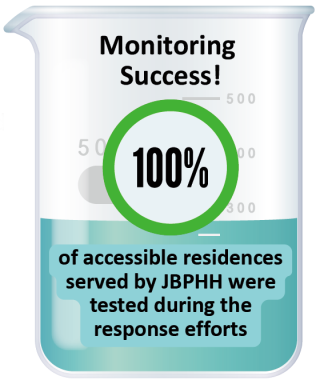
Long-Term Monitoring (LTM): was implemented to verify the conclusion of the emergency response action; requiring Navy to sample the source, distribution lines, and the residences for 24 months (Mar 2022-Mar 2024).
Extended Drinking Water Monitoring (EDWM): focused on fuel-related analytes to identify potential residual contamination from the Nov 2021 fuel release to the drinking water system (Apr 2024-Apr 2025) . Navy committed to testing residences/buildings not previously tested during LTM.
EPA Monitoring (Split Samples): EPA performed split sample analyses to independently evaluate the validity of the Navy’s data. Throughout EDWM, EPA’s split samples were aligned with the Navy’s results. Anomalies detected were further investigated and confirmed not to be fuel-related.
Inspections and Investigations
Between April 2022 and October 2024, EPA conducted five inspections, investigations, and audits to evaluate the quality of drinking water and effectiveness of the Navy’s monitoring and management of the JBPHH system.
Since March 2022, the drinking water has met all standards under the Safe Drinking Water Act and Hawaiʻi Department of Health’s Incident Specific Parameters. Navy continues monitoring to ensure drinking water continues to meet Safe Drinking Water Act standards.
Total Petroleum Hydrocarbons
- Total Petroleum Hydrocarbon (TPH) testing was only used as a screening method for fuel because there is not an Maximum Contaminant Level for TPH under the Safe Drinking Water Act.
- TPH testing detects a broad array of hydrocarbons and mixtures including anything from fuel and lubricants to mineral oils.
- In-depth analyses and investigations on TPH detections conducted by EPA, Navy, and DOH concluded that there is no fuel-related contamination in the drinking water systems.
Ongoing Efforts
- Infrastructure Improvements: EPA continues to oversee improvements to Navy operations and infrastructure of the JBPHH drinking water system under the 2023 Administrative Consent Order.
- Environmental Cleanup: EPA continues to oversee the Navy's investigation and remediation of contaminated soil and groundwater from past fuel releases.
- Routine Drinking Water Testing: Navy will continue routine testing per state/federal drinking water requirements and address consumer concerns through the Water Quality Action Team.