


Sulfur Averaging, Banking, and Trading (ABT) Credit Data
Overview of Fuels ABT Program
EPA administers two separate Averaging, Banking, and Trading programs for sulfur and benzene under federal gasoline regulations. Refiners and importers may generate compliance credits by producing gasoline that meets the applicable standards and they may trade credits with other regulated parties to demonstrate compliance. EPA tracks generation, trades and retirement of sulfur and benzene ABT credits in EPAs Moderated Transaction System.
Learn more:
Sulfur ABT Credit Status by Averaging Year
Refiners and importers are subject to the sulfur standards in 40 CFR §1090.205. The annual average gasoline sulfur standard is the average sulfur level allowed for gasoline produced at a refinery or imported by an importer during each compliance period, organized by calendar year. Refiners and importers may use banked credits purchased from other refineries or importers to meet the standard. If a refinery or importer does not have enough credits and its sulfur level is above the standard, it creates a sulfur credit deficit. A deficit may be carried forward up to one compliance period.
The table below shows the volume weighted averages and total gasoline volumes before sulfur credits are applied for gasoline produced and imported that was above, below or equal to the sulfur standard by compliance period. The total gasoline volumes and VWA are based on refinery and importer values reported in their Sulfur Annual Compliance report.
You can download the selected dataset to an Excel file by right-clicking inside a table and selecting "Export data."
Gasoline Sulfur Credit Generation and Retirement
Generation
The table below describes how sulfur credits are generated. Sulfur credits are measured in ppm-gallons. The Net Credits Generated column shows the total credits generated minus any invalid credits generated. Credit Generation Error Corrections are credits that were retired in EMTS using the 'Invalid Credit' or 'Volume Error Correction' retirement reason codes.
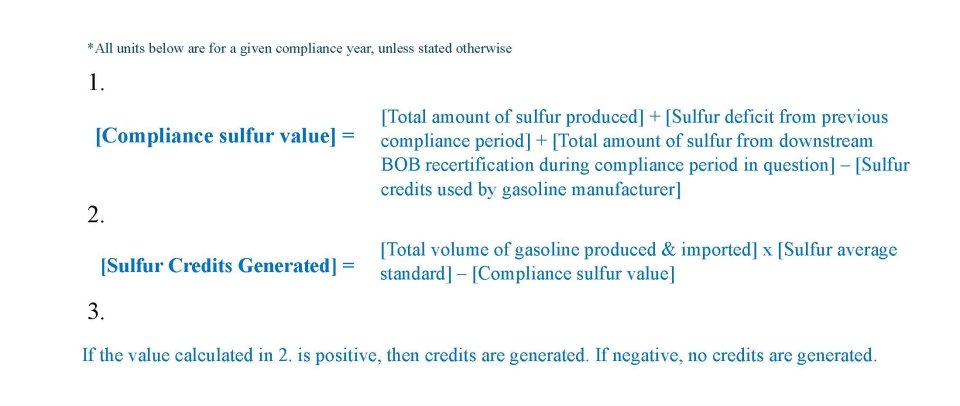
Text for image: To calculate sulfur credits generated:
- Calculate the compliance sulfur value by adding:
- total sulfur produced
- sulfur deficit from the previous compliance period
- sulfur from downstream BOB recertification during the compliance period
- then subtract sulfur credits used by the gasoline manufacturer
- Multiply the total volume of gasoline produced and imported by the sulfur average standard. Subtract the compliance sulfur value from the result in step 2.
- If the value calculated in step 2 is positive, then credits are generated. If negative, no credits are generated.
Retirements
Gasoline refineries and importers may retire sulfur credits to meet the annual sulfur standard when their actual annual average sulfur level is greater than 10 ppm. In general, refiners and importers can retire credits for compliance that were created within the previous five averaging periods.
The tables below provide summary totals of gasoline sulfur credits generated and retired in EMTS:
- Table 2: Gasoline Sulfur Credits generated in EMTS
- Table 3: Gasoline Transitional Sulfur Credits generated in EMTS by Small Volume Refineries and Small Refiners (program retired after calendar year 2019)
- Table 4: Gasoline Sulfur Credits retired for compliance in EMTS by Domestic Refineries
- Table 5: Gasoline Sulfur Credits retired for compliance in EMTS by Importers
- Table 6. Total retired gasoline sulfur credits
- Table 7. Total retired gasoline transitional sulfur credits for averaging periods 2017, 2018, and 2019