


Overview of CDR Reporting
Every four years, manufacturers (including importers) submit Chemical Data Reporting (CDR) data to EPA. EPA makes these data publicly available. This webpage is intended for those who report under CDR.
- Where can I find CDR training and guidance materials?
- Is my site required to report to the CDR Program?
- What are the steps in the CDR reporting process?
- What chemicals are not required to be reported?
- Which manufacturers are exempt from reporting?
What do I need to know about electronic CDR reporting?
Where Can I Find CDR Training and Guidance Materials?
Through CDR GuideME, you can access reporting instructions, questions and answers, chemical- and industry- specific guidance, training materials, and more.
Is My Site Required to Report to the CDR Program?
A site that domestically manufactures or imports a chemical substance for commercial purposes, including importing a product or other mixture, is required to report if:
- The site meets or exceeds the applicable chemical production threshold (25,000 pounds or 2,500 pounds; see the chemical status spreadsheet linked below) within any single calendar year since the last principal year, and
- The chemical substance is on the TSCA Inventory as of the start of the submission period and is not specifically exempted.
- See Section 2.1 of the Instructions for Reporting for flow diagrams that will help you determine if you need to report, including the consideration of activity-based exemptions or company size-specific exemptions.
- The term “site” refers to the location that physically manufactures the reportable chemical within the United States and/or is directly responsible for importing the chemical into the United States.
EPA's 2024 CDR Chemical Status Spreadsheet (xlsx) lists reportable chemicals, applicable reporting thresholds, and applicable TSCA actions. This spreadsheet relates to the 2024 CDR submissions.
- EPA updates this spreadsheet by June 1 of each submission year (e.g., 2024 or 2028).
- Table B-2 in the CDR Instructions indicates which threshold and exemptions are relevant to a chemical based on what TSCA actions, if any, are applicable to the chemical.
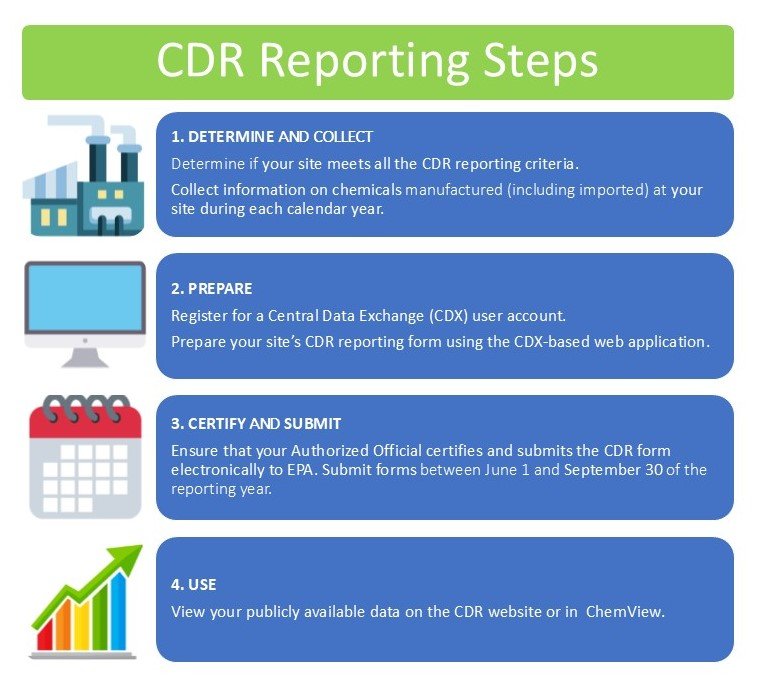
What Are the Steps in the CDR Reporting Process?
The image below summarizes the CDR reporting process. For more detailed information about each step, refer to the Reporting Instructions.
What Chemicals Are Not Required to be Reported?
Manufacturers (including importers) may not be required to report information on certain chemicals due to the applicable definition of “chemical substance,” exemptions, or the manner of manufacture.
- Definition of Chemical Substance:
- See the TSCA definition of a chemical substance
- See the TSCA Inventory description of a chemical substance.
- Chemicals manufactured (including imported) for only non-TSCA uses are not required to be reported (e.g., pesticides are exempt from reporting under CDR).
- Information on the portion of any manufacture (including import) for TSCA uses involving a given chemical, whether on site or downstream, is reportable to CDR.
- Type of Chemical:
- Generally, water, naturally occurring substances, polymers, microorganisms, and certain forms of natural gas are exempt from CDR requirements.
- A particular polymer, microorganism, or form of natural gas may not be exempt if the chemical is the subject of certain TSCA actions (e.g., a TSCA Section 4 test order or a SNUR).
- To determine chemical status as it relates to TSCA actions, you can search in EPA’s Substance Registry Services or download EPA's 2024 CDR Chemical Status Spreadsheet (xlsx) , which contains all of the TSCA Inventory chemicals (both active and inactive) and the TSCA actions that affected reporting requirements for the 2024 CDR.
- Manner of Manufacture:
- Chemicals that are non-isolated intermediates, imported as part of an article, impurities, or byproducts destined for certain commercial uses are exempt from reporting.
What Manufacturers Are Exempt from Reporting?
Small manufacturers, as defined in 40 CFR 704.3, are exempt from reporting. For CDR, a small manufacturer is a company that has:
- Total annual sales combined with those of the parent company, domestic or foreign (if any), of less than $12 million, or
- Total sales of the parent company, domestic or foreign (if any), of less than $120 million and annual production volume for each of the covered years of a qualifying chemical substance below 100,000 pounds at any individual plant site. If the annual production volume of the chemical substance at any site exceeds 100,000 pounds, the manufacturer is required to report for that particular site.
What Do I Need to Know About Electronic CDR Reporting?
- All companies must report CDR data electronically using e-CDRweb, available through EPA's Central Data Exchange (CDX).
- Individuals involved with completing the CDR reporting form can register in CDX at any time. The CDX Chemical Safety and Pesticide Programs (CSPP) Registration User Guide walks through the CDX registration process.
- For more instructions, go to CDR GuideME.
User Roles
When registering, make sure you sign up for the appropriate CDR-related user role. The user roles are:
- Authorized Official (AO): An AO can create, amend, unlock, and submit the CDR form electronically to EPA. The AO can assign Supports (including Agent/Consultants) to individual sites. A site can have multiple AOs.
- Tip: Set up an email address (like AO@company.com) for TSCA reporting. The company controls access to the email and retains the ability to reset passphrases (which is tied to the email address used to create the site’s reporting form).
- Agent/Consultant: An Agent/Consultant can create, amend, and/or unlock the CDR form. The Agent can only submit amended forms to EPA.
- An Agent/Consultant is often with another company.
- Note that the email used to reset the passphrase is associated with the person creating the form.
- Support: A Support can modify any unlocked form that he/she is assigned to by the Authorized Official.
The CDR Form U is the official form used by manufacturers (including importers) to submit required information about chemical substances including production volumes, manufacturing sites, and processing and use data. Form U has two versions. Form U is completed using the e-CDRweb reporting tool:
- A primary version for domestic reporters (accessed through the Primary Authorized Official role for the CDX CSPP program service), and
- A secondary version for non-domestic suppliers reporting at the request of primary form submitters (accessed through the Secondary Authorized Official role for the CDX CSPP program service).
These roles are described in more detail in the CDX Chemical Safety and Pesticide Programs Registration User Guide. For additional information, please see the User Role Registration Quick Reference Guide.