


Status and Progress
2025 Progress Report
Every three years Canada and the U.S. produce a comprehensive report on progress made toward attainment of the goals of the Great Lakes Water Quality Agreement. The 2023-2025 Progress Report of the Parties (pdf) (877 KB) report was released in January 2026. Here we summarize the current status and progress being made under Annex 4.
New programming and enhanced support for on-the-ground actions to reduce sources of phosphorus to Lake Erie as identified in the Domestic Action Plans are slowing phosphorus inputs that cause algae blooms in the lake. Still, Lake Erie continues to exhibit eutrophic conditions and the major tributaries routinely exceed target levels. In addition, smaller tributaries can still at times contribute high concentrations of phosphorus leading to smaller, but still significant, localized algal blooms.
Load reductions are difficult to discern, as phosphorus loads continue to be largely driven by precipitation (e.g., rain events) and discharge from rivers, which vary from year-to-year. In-lake responses (nutrient concentrations, HABs, hypoxia, and nuisance algae) also show high year-to-year variability.
The good news is that there are some indications water quality has improved since the U.S. and Canada set forth the commitment to reduce phosphorus loads to the lake by 40% in 2016.
The severity of harmful algal blooms has been “mild” since 2020 according to National Oceanic and Atmospheric Administration’s (NOAA) annual assessment. Between 2017 and 2024, the bloom severity target was met in 2018, 2020, and 2023. Blooms from 2021-2024 were less intense with fewer “scum” events compared to the 2010s.
In the Maumee River, the largest source of phosphorus to the lake, the amount of soluble phosphorus being delivered during the spring months has declined. Some of this decline is a result of drier conditions, but when we take lowered streamflows into account, we see a decline of up to 10% more than we would expect, which indicates a true reduction in sources. The reduction in soluble phosphorus is a sign of success because it is more easily taken up by algae, and the single best predictor of the chronic and massive harmful algal blooms that span the western half of the lake each summer.
Major Projects and Accomplishments
Significant efforts are underway to reduce phosphorus loads that, when sustained, targeted and given time to be effective, will provide major improvements to Lake Erie water quality.
- Programs to Reduce Phosphorus Loadings from Agricultural Sources
- Programs to Reduce Phosphorus Loadings from Municipal Sources
- Watershed-Based Strategies
- Science, Research, and Monitoring
- Communication and Outreach
Programs to Reduce Phosphorus Loadings from Agricultural Sources
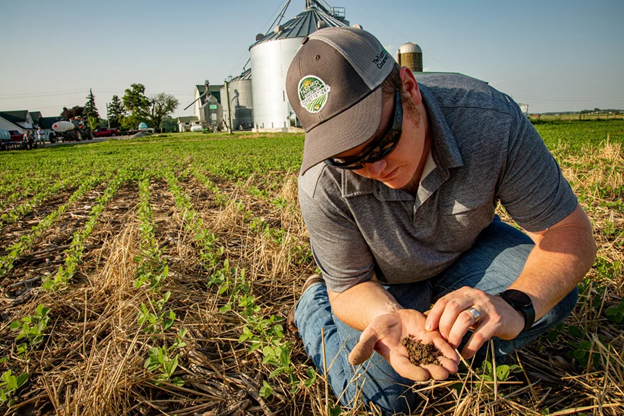
- Widespread farmer engagement in the WLEB. Federal and state agencies in the U.S. have significantly increased technical and assistance to farmers over the past several years, and enrollment in voluntary conservation programs is at a record high. As of 2025, about half of the 4 million acres of cropland in the western Lake Erie watershed (WLEB) is enrolled the H2Ohio Initiative. This is an outstanding adoption level, that if maintained will significantly reduce phosphorus contributions from agricultural sources to Lake Erie.
- USDA conservation efforts to reduce phosphorus loads to Lake Erie. From 2018-2023, the United States Department of Agriculture’s Natural Resources Conservation Service (USDA NRCS) doubled the amount of financial assistance available to farmers in the Lake Erie watershed. The Agency executed more than 3,000 cost-sharing contracts with private landowners, covering over 742,000 cropland acres. Approximately 30 percent of the contracts went to nutrient management practices, 41 percent to cover crops, and 20 percent to animal waste storage and management. Read more about NRCS programming in the WLEB.
- H2Ohio Initiative. Since the program’s inception in 2019, $250 million in H2Ohio funding has been allocated by Ohio Department of Agriculture to support cropland nutrient management in the WLEB. More than 2,600 farmers have enrolled 1.85 million acres of farmland across the 24 counties that make up the WLEB watershed. Farmers enrolled in H2Ohio kept 420,000 pounds of phosphorus out of Ohio’s waterways in 2024. Additionally, H2Ohio funds are being used to construct and enhance 183 wetland projects in the watershed and establish a long-term monitoring program to evaluate how well wetlands retain nutrients. These programs are producing measurable environmental and economic benefits to Ohio residents. Read the report on the economics of restoring watersheds.
- Great Lakes Restoration Initiative (GLRI). Phosphorus reduction and HABs are a funding priority under the GLRI. Approximately $22 million in GLRI funding is invested in Lake Erie nutrient reduction efforts each year, with about 85 percent used for on-the-ground projects and 15 percent for the supporting science. EPA created a new GLRI funding opportunity to enhance technical assistance and outreach to farmers in the WLEB, awarding $3.7 million for state and locally-led projects in 2025.
- Farmers mentoring other farmers. An EPA GLRI grant to The Nature Conservancy supported a pilot project that successfully recruited 26 "Farmer Advocates" to train and mentor others on conservation practices. From 2020-2024, the mentors, who manage 28,590 acres themselves, directly engaged over 11,680 farmers in the Maumee River watershed through workshops, field days, and one-on-one interactions. The goal is to expand the program across Ohio to train 1-3 farmers in each county and continue building a culture of conservation in the region.
Programs to Reduce Phosphorus Loadings from Municipal Sources
- Michigan lowers phosphorus contributions from municipal wastewater facilities in the WLEB. Michigan’s major improvements in facility operations and stricter permit requirements have significantly reduced phosphorus loading to Lake Erie. These reductions are especially attributable to the Great Lakes Water Authority, the Detroit region’s primary municipal wastewater service provider, where annual total phosphorus (TP) loads have been reduced by over 55 percent. Building on this success, Michigan Department of Environment, Great Lakes, and Energy (EGLE) established a framework for achieving a 0.5 mg/L TP effluent limit (i.e., a growing season average) at all 25 major publicly owned wastewater treatment facilities located within the WLEB. To help facilities meet the lower TP effluent limits, EGLE published Phosphorus Removal Guidance for Wastewater Utilities in Michigan's Western Lake Erie Basin, a document that describes low-cost, practical methods to optimize phosphorus removal, in October 2024.
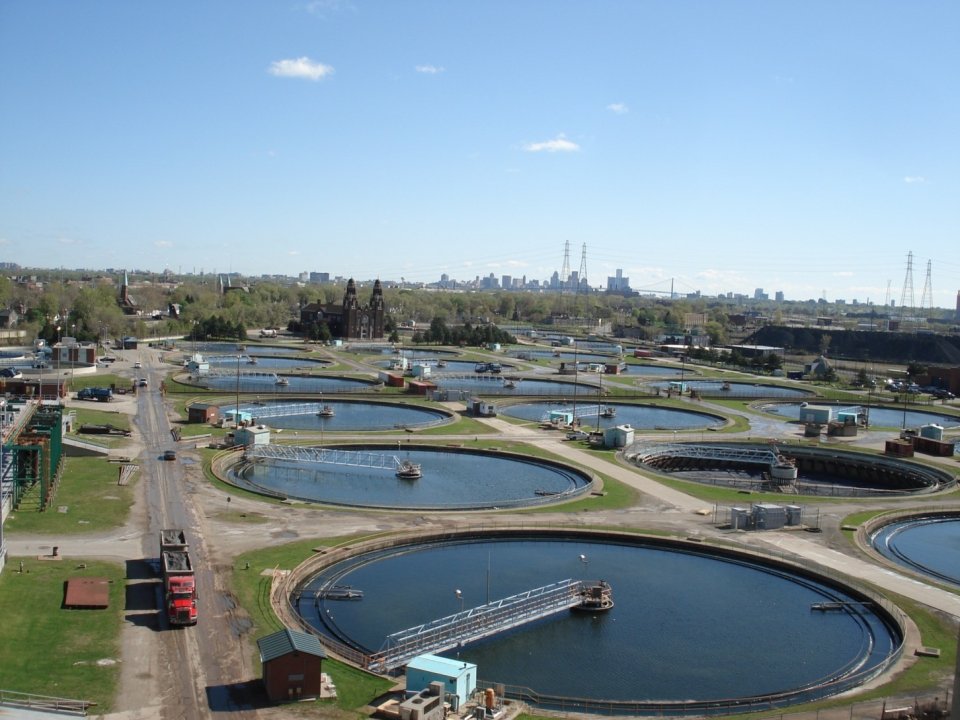
- Fort Wayne Deep Tunnel. In Indiana, 5 miles of the Fort Wayne Deep Tunnel project, an essential part of its Combined Sewer Overflow (CSO) long-term control plan, became operational in 2024, one year ahead of schedule. The final phase, a pumping station, is currently under construction and will mark the official completion of the project. The Deep Tunnel project will reduce CSOs into the St. Marys and Maumee rivers from 72 per year to four per year or fewer.
- New York updates phosphorus guidance. In December 2024, New York State Department of Environmental Conservation (NYSDEC) released draft water quality guidance values for phosphorus that will advance the state’s regulation of phosphorus in ambient freshwaters.
Watershed-Based Strategies
- New expanded water quality monitoring network and field inventories. Michigan is implementing a strategic and targeted approach to reduce nonpoint source pollution. Five subwatersheds within Michigan’s portion of the WLEB were selected for focused and accelerated activities including completing agricultural inventories, finer-scale water quality monitoring, and prioritized conservation practice implementation.
- Maumee Watershed Nutrient Total Maximum Daily Load (TMDL). Ohio EPA finalized and submitted the Maumee Watershed Nutrient TMDL to EPA in June 2023. The TMDL identifies phosphorus load allocations for point source and nonpoint source pollution occurring throughout Ohio’s portion of the Maumee drainage basin to meet the reduction goals established under Annex 4. It includes an implementation strategy which identifies several mechanisms and funding programs that state and local entities can utilize to reduce phosphorus loads. The first Biennial report on progress was issued in 2024.
- USDA measures the effectiveness of conservation efforts through a partnership between USDA NRCS Conservation Effects Assessment Project (CEAP), USDA Agricultural Research Service and university partners. Findings from an extensive edge-of-field monitoring network, from two small watershed studies and from basin scale modeling analysis have been used by NRCS, U.S. Environmental Protection Agency (EPA) and states to inform effective conservation strategies and document the outcomes of farmer’s voluntary conservation actions. Check out this informational video for a closer look at the collaborative partnerships driving innovative water quality assessment and conservation in the WLEB.

Science, Research, and Monitoring
- Supporting science under GLRI. From 2023 to 2025, NOAA, United States Geological Service (USGS), and United States Army Corps of Engineers (USACE) conducted over $15 million in critical science activities to support Lake Erie nutrient-reduction goals. These federal partners provide essential HABs monitoring and decision-support tools to track and forecast blooms; tributary and edge-of-field monitoring and nutrient load computations; and ecosystem and watershed modeling.
- Expanding NOAA HABs Forecast Capabilities. The Lake Erie HAB forecasts continue to be refined with the latest technologies available, and researchers are getting closer to being able to predict whether blooms are likely to be toxic. In 2023 and 2024, the NOAA Great Lakes Environmental Research Laboratory deployed a network of sophisticated instruments in Lake Erie that can collect and analyze water samples in situ to provide near-real time measurements of the dangerous toxin often present in these blooms, microcystin. NOAA is planning to expand their bloom forecasts to include a prediction on the probability of exceeding toxin threshold levels in 2026.
- Great Lakes Tributary Water Quality Dashboard. USGS has been monitoring water quality in 24 U.S. tributaries to the Great Lakes since 2011. A recent analysis found that when corrected for flow, total phosphorus loads have decreased or remained steady in most (21 of the 24) of the monitored tributaries, indicating widespread progress toward the nutrient reduction goals of the GLRI and the Great Lakes Water Quality Agreement. All of the results of this analysis are published on an interactive, web-based dashboard, at USGS webpage and will be regularly updated as new data become available.
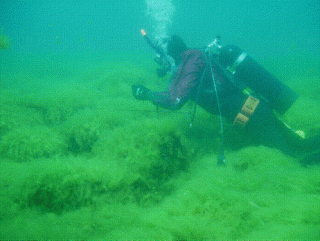
- Cladophora monitoring. USGS is monitoring Cladophora growth at two locations in Lake Erie near Erie, PA and Dunkirk, NY. There they use a combination of diver-led monitoring and in-situ sensors to better understand distribution, algal community dynamics, and drivers of growth. USGS is also testing new methods to remotely sense Cladophora using autonomous underwater vehicles. NYSDEC has been working to increase awareness of nuisance Cladophora growth by launching Cladophora Along the Great Lakes Shorelines, a web page and a geographic information system-based reporting tool to encourage citizens to report occurrences of Cladophora along Great Lakes shorelines.
- Ohio Department of Higher Education Harmful Algal Bloom Research Initiative (HABRI). HABRI is a statewide research program created in 2015 in response to the 2014 Toledo HAB toxin drinking water advisory. From 2015 - 2025, Ohio invested $24 million in funds for 115 HABs projects to 15 Ohio-based universities. Projects are selected with input from state agencies, and the program has been extremely successful at providing quick and reliable information to address their needs and knowledge gaps.
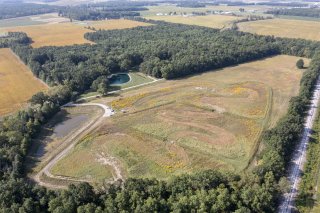
- Wetlands research. In 2020, USACE constructed a 10-acre demonstration wetland in Defiance, Ohio, to serve as a model for optimizing phosphorus retention and nonpoint source reduction in agricultural settings. Monitoring data at the site shows phosphorus losses are being reduced by ~50%. The innovative project coordinates with federal partners, including EPA, NRCS, and USGS, as well as partners at the state and local level, to share lessons learned and inform other wetland restoration project designs to maximize efficiency. USACE is partnering with City of St. Marys to build a second wetland in 2027.
Communication and Outreach
- Engaging Stakeholders in Michigan. Implementation of Michigan’s Domestic Action Plan is guided by 65 state and local members of The Western Lake Erie Basin Community Advisory Group. This diverse group of partners brings together science, policy, and local perspectives to drive meaningful action. Since forming in 2023, the advisory group has provided opportunities for education and networking, including an annual conference facilitated by the University of Michigan Water Center.
- Coordination and Outreach through Ohio Sea Grant. Ohio stakeholders are engaged in phosphorus reduction efforts and HABs in numerous ways. At the start of each summer, NOAA and Ohio Sea Grant host a live web event to review the upcoming Lake Erie Harmful Algal Bloom forecast. This popular event features regional experts, policy makers, and a briefing for media. Ohio Sea Grant also hosts an annual “Understanding Algal Blooms: State of the Science Conference” in September to bring researchers and water quality managers together to review the current scientific knowledge related to algal blooms.
- Tri-State WLEB Partnership. Since 2006, the multi-agency Western Lake Erie Basin Partnership has provided a platform for collaboration between federal partners and the states of Ohio, Indiana and Michigan. In 2023, EPA signed on as a tri-chair with NRCS and USACE, and the agencies together initiated an effort to re-invigorate the Partnership and resume pre-COVID level engagement. More frequent meetings and field tours are improving public communication of the work the partnership does to accelerate achievement of phosphorus reduction goals. A celebration commemorating the 20th anniversary of the Partnership is planned for 2026.