U.S. flag

An official website of the United States government

Here’s how you know

Dot gov

Official websites use .gov
A .gov website belongs to an official government organization in the United States.

HTTPS

Secure .gov websites use HTTPS
A lock (LockA locked padlock) or https:// means you’ve safely connected to the .gov website. Share sensitive information only on official, secure websites.

    • Environmental Topics
    • Air
    • Bed Bugs
    • Chemicals, Toxics, and Pesticide
    • Emergency Response
    • Environmental Information by Location
    • Health
    • Land, Waste, and Cleanup
    • Lead
    • Mold
    • Radon
    • Research
    • Science Topics
    • Water Topics
    • A-Z Topic Index
    • Laws & Regulations
    • By Business Sector
    • By Topic
    • Compliance
    • Enforcement
    • Guidance
    • Laws and Executive Orders
    • Regulations
    • Report a Violation
    • Environmental Violations
    • Fraud, Waste or Abuse
    • About EPA
    • Our Mission and What We Do
    • Headquarters Offices
    • Regional Offices
    • Labs and Research Centers
    • Planning, Budget, and Results
    • Organization Chart
    • EPA History

Breadcrumb

  1. Home
  2. International Cooperation

International Efforts on Wasted Food Recovery
The UN Food and Agriculture Organization estimates that around the world about a third of food intended for human consumption is lost or wasted. This amounts to over a billion tons of food and $940 billion in economic losses annually, while one in nine people remain undernourished. In the United States, 40% of food is lost or wasted, annually costing an estimated $218 billion or 1.3% of GDP. Food accounts for 24% of solid waste ending up in U.S. landfills. Reducing this wasted food presents opportunities to increase food security, foster productivity and economic efficiency, and promote resource and energy conservation. 
 
In 2023, the value of surplus food reached $382 billion, of this, 88% ($338 billion) was due to food waste. The U.S. Government has set a food waste reduction goal that aims to cut the amount of food waste in the retail, food service, and residential sectors in half by 2030. Investing $14 billion in cost-effective solutions per year could reduce food waste by 45 million tons each year, which would result in $73 billion in annual net financial benefit for the U.S., save four trillion gallons of water, recover the equivalent of four billion meals for people in need, and create more than 51,000 jobs.  (Source: ReFED, “Roadmap to 2030: Reducing U.S. Food Waste by 50% and the ReFED Insights Engine” (2021)).
 
 
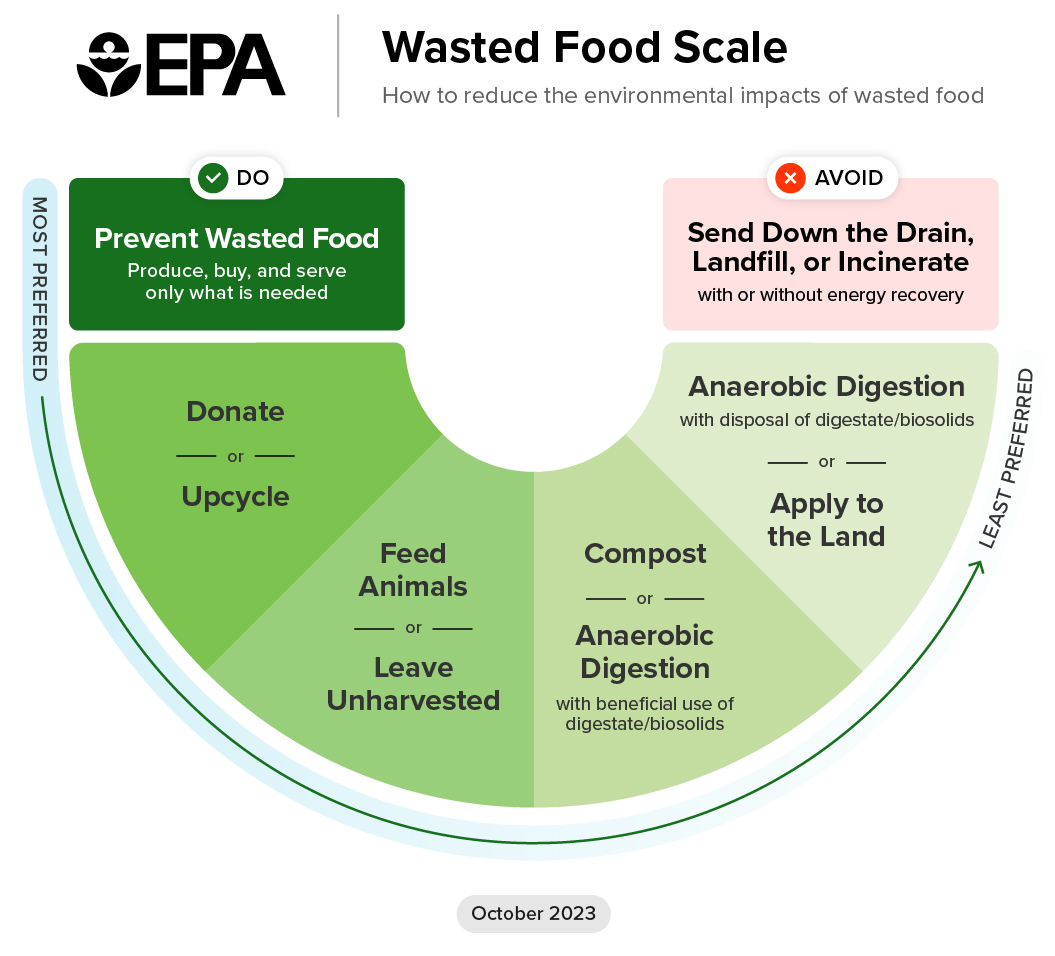
EPA’s Wasted Food Scale is a curved spectrum showing options for reducing the environmental impacts of wasted food, from most preferred to least preferred.
Click to enlarge.

EPA's Wasted Food Scale framework provides a basis for many domestic and international food waste reduction strategies. The Wasted Food Scale is based on the results of a report evaluating the environmental impacts of common wasted food management pathways in the U.S. In 2015, EPA and USDA announced a goal to reduce food waste in the U.S. by 50% by 2030. Almost 50 businesses have joined the 2030 Champions group by committing to reduce food loss and waste in their U.S. operations by 50% by 2030. In 2016, the U.S. Conference of Mayors adopted a resolution supporting a multi stakeholder partnership to achieve the 50% reduction goal. In April 2019, EPA, USDA, and the FDA announced the release of a federal interagency strategy to address food waste, as part of the Winning on Reducing Food Waste Initiative. In October 2023, EPA released the Wasted Food Scale, replacing the Food Recovery Hierarchy that was from the 1990s. To learn more, visit EPA's Sustainable Management of Food website.  In September 2025, EPA announced the launch of Feed It Onward, a new national initiative designed to reduce food waste and strengthen food security across America. Feed It Onward is a voluntary program that partners with farms, restaurants, grocery stores, food brands, and military bases donating food within their communities.


International Efforts to Address Food Waste

Working internationally, EPA has elevated awareness of and commitments to food waste reduction.  
 
 In April 2025, the North American Commission on Environmental Cooperation (CEC) launched a new project, Using the World Cup and Large-Scale Events to Raise Awareness about the Importance of Reducing Food Waste, which aims to raise awareness about food waste during the World Cup by developing and outreach assets and a guide for implementers such as municipalities, event organizers, and stadiums  to use. Building on learnings from the World Cup, CEC will also develop generic materials that municipal and local governments, as well as event managers and organizers, sports venues, and other organizations can use for many types of large-scale public events.
 
In May 2024, the North American Commission on Environmental Cooperation (CEC) launched the ongoing project Stimulating Behavioral Changes to Reduce Food Loss and Waste (FLW) in North America and Expanded Promotion and Uptake of Related CEC FLW Resources. Building on previous CEC FLW projects, this follow-up project will enable the CEC to continue its current momentum and visibility in awareness-raising of FLW issues, promoting related existing CEC products, and developing new CEC products to promote behavioral changes and further support FLW reduction in North America.  
 

In April 2019, the North American Commission on Environmental Cooperation (CEC) launched two products.

  • A Technical report and Practical guide to address food loss and waste throughout the food chain using measurement tools based on scientific, proven principles. The guide provides easy-to-use measurements and information for every segment of the food value chain – from primary production to manufacturing and the food service industry. The Technical Report and the Practical Guide are available in English, French, and Spanish.
  • The Food Matters Action Kit,  a youth engagement toolkit containing activities designed for youth across North America to prevent food waste in their homes and communities. These twenty activities are arranged for two age groups, one for kids, ages 5-13 and another for youth, ages 14-25. Individuals, teams of friends, or clubs and organizations can register to document their achievements, earn shareable Food Waste Hero badges and challenge others on this site.

EPA, Environment and Climate Change Canada and Mexico’s SEMARNAT (Department of Environmental and Natural Resources) have been collaborating since 2015 on preventing and minimizing food loss and waste as a shared North American priority area through the CEC. The CEC efforts continue under the Measuring and Reducing Food Loss and Waste project, which is working to effectively measure food loss and waste in the North American food chain; calculate its environmental and socioeconomic impacts; and provide tools and education to prevent and reduce loss and its impacts on food security, the economy, and the environment in North America.

EPA also supported a report by the UN Environment Programme North America Office titled, “Waste Not, Want Not: Reducing Food Loss and Waste in North America Through Life Cycle-Based Approaches,” released during UNEA-4. The report examines how life cycle thinking and related tools such as life cycle assessment can be used to inform effective policy making to reduce food loss and waste. Case studies in the report highlight examples of how lifecycle thinking is already being used successfully to reduce food loss and waste in North America. 

EPA continues to reinforce the importance of addressing food loss and waste in multilateral engagements with organizations such as UN Environment, G7 and G20 fora, World Bank, OECD, UN Food and Agriculture Organization and the World Resources Institute. 
 

International Cooperation

  • Where We Work
  • Resources
  • Schedule a Visit
Contact Us about International Cooperation
Contact Us about International Cooperation to ask a question, provide feedback, or report a problem.
Last updated on January 7, 2026
  • Assistance
  • Spanish
  • Arabic
  • Chinese (simplified)
  • Chinese (traditional)
  • French
  • Haitian Creole
  • Korean
  • Portuguese
  • Russian
  • Tagalog
  • Vietnamese
United States Environmental Protection Agency

Discover.

  • Accessibility Statement
  • Budget & Performance
  • Contracting
  • EPA www Web Snapshot
  • Grants
  • No FEAR Act Data
  • Plain Writing
  • Privacy and Security Notice

Connect.

  • Data
  • Inspector General
  • Jobs
  • Newsroom
  • Regulations.gov
  • Subscribe
  • USA.gov
  • White House

Ask.

  • Contact EPA
  • EPA Disclaimers
  • Hotlines
  • FOIA Requests
  • Frequent Questions
  • Site Feedback

Follow.