


EPA's Leadership under the Federal Action Plan to Reduce Childhood Lead Exposure
The Federal Action Plan to Reduce Childhood Lead Exposures and Associated Health Impacts (Federal Lead Action Plan) is a blueprint for reducing lead exposure and associated harms through collaboration among federal agencies and with a range of stakeholders – including states, Tribes and local communities, along with businesses, property owners, parents, and other members of the public. The Federal Lead Action Plan helps federal agencies work strategically and collaboratively to reduce exposure to lead with the aim of ultimately improving children’s health.
EPA's Commitments on Lead
The United States has made tremendous progress in lowering children’s blood lead levels over the last 50 years, but potential exposures to lead in the home and environment still present a health risk to many people nationwide, especially children. Recognizing the need to ensure continued progress in reducing lead exposure, the Trump Administration reconstituted EPA’s Senior Leadership Lead Coordinating Committee to support the agency’s mission of protecting human health and the environment under the leadership of Administrator Zeldin.
EPA is continuing to work under the government-wide 2018 Federal Lead Action Plan, by addressing lead under various statutory authorities and responsibilities, including the Toxic Substances Control Act (TSCA), Comprehensive Environmental Response, Compensation, and Liability Act (CERLCA), Resource Conservation and Recovery Act (RCRA), Clean Air Act (CAA), Clean Water Act (CWA), and Safe Drinking Water Act (SDWA). In support of Administrator Zeldin’s Powering the Great American Comeback initiative, EPA is advancing the following cross-agency approaches to expand the reach of its impact to reduce lead exposures:
- Align EPA to support state, local and Tribal government action under a cooperative federalism model.
- Streamline and promote effective risk communications to support individuals with information to take further action to protect themselves and their communities.
- Unleash private sector innovation and impact through public-private partnerships as a convener and certifier of credibility.
Learn more about the Agency’s FY 2026 commitments listed by individual Federal Lead Action Plan objective. Assembling these commitments enables EPA to transparently track its progress in addressing lead contamination and exposure prevention.
About the Federal Lead Action Plan
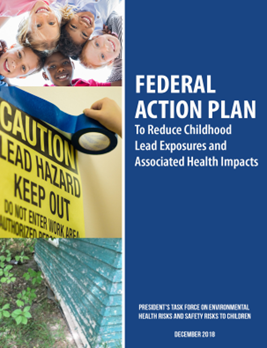
The Federal Action Plan to Reduce Childhood Lead Exposures and Associated Health Impacts (pdf) (or Federal Lead Action Plan) has four goals with key priorities and objectives that seek to reduce harm to children from exposure to lead. By identifying specific goals and actions, federal agencies can prioritize their efforts and monitor progress. The four goals are:
- Goal 1: Reduce children's exposure to lead sources.
- Goal 2: Identify lead-exposed children and improve their health outcomes.
- Goal 3: Communicate more effectively with stakeholders.
- Goal 4: Support and conduct critical research to inform efforts to reduce lead exposures and related health risks.
The Federal Lead Action Plan is the product of the President’s Task Force on Environmental Health Risks and Safety Risks to Children (Task Force). The Task Force is the focal point for federal collaboration to promote and protect children’s environmental health. Established in 1997 by Executive Order 13045 – Protection of Children from Environmental Health Risks and Safety Risks, the Task Force comprises 17 federal departments and offices. The Secretary of the Department of Health and Human Services (HHS) and the Administrator of the Environmental Protection Agency (EPA) co-chair the Task Force.
Progress on the Federal Lead Action Plan
2026
In April, the Task Force published a comprehensive update on efforts by the federal government and advancements made in FY 2025, specifically between May 2024 and September 2025. The progress reflects a continued, whole-of-government commitment to the goals outlined in the FY 2025 Progress Report on the Federal Lead Action Plan (pdf) .
2024
In May, the Task Force Reports Progress on the Federal Lead Action Plan published a comprehensive update on efforts by the federal government and advancements made between December 2018 and April 2024 in reducing childhood lead exposures and associated health effects: Progress Report on the Federal Lead Action Plan: December 2018 – April 2024.
Read the prior results for EPA’s progress under the Federal Lead Action Plan.
2022
In October, EPA issued the Strategy to Reduce Lead Exposures and Disparities in U.S. Communities (pdf) (Lead Strategy) to advance EPA’s work to protect the public from lead with an emphasis on high-risk communities. Under this strategy, EPA focused on eliminating the disparities in blood lead levels by taking specific actions to prevent childhood exposures and exposure inequities that could lead to lifelong health effects and barriers to social and economic well-being. The Lead Strategy set out four goals which aligned with the 2018 Federal Lead Action Plan and the Fiscal Year 2022-2026 EPA Strategic Plan. EPA’s efforts under the Lead Strategy have concluded and are now organized under new milestones for FY 2026.
Read the results for EPA’s Lead Strategy performance measures and milestones.
- FY 2025 EPA Lead (Pb) Strategy Performance Measures and Milestones (pdf)
- FY 2024 Results for EPA Lead (Pb) Strategy Performance Measures and Milestones (pdf)
- FY 2023 Results for EPA Lead (Pb) Strategy Performance Measures and Milestones (pdf)
- FACT SHEET Strategy to Reduce Lead Exposures and Disparities in U.S. Communities (pdf)
- Información relacionado en español
2021
In October, engaging the Agency’s many stakeholders and with federal, Tribal, state, and local government partners was an integral part of developing this Lead Strategy. On October 28, 2021, EPA released the Draft Strategy to Reduce Lead Exposures and Disparities in U.S. Communities (pdf) and solicited feedback from the public through March of 2022. Comments can be found on the docket at Regulations.gov (docket EPA-HQ-OLEM-2021-0762).
2019
In October, EPA released a progress report, Progress Report on the Federal Action Plan to Reduce Childhood Lead Exposures and Associated Health Impacts (pdf) , on how the agency has approached EPA-specific goals, objectives and actions under the Federal Lead Action Plan.
In April, former EPA Administrator Andrew Wheeler made a commitment to develop an implementation plan to enable EPA to track its progress and update the public on its work to carry out the Lead Action Plan. In April 2019, EPA released the Implementation Status Report for EPA Actions under the December 2018 Federal Action Plan to Reduce Childhood Lead Exposures and Associated Health Impacts (pdf) , describing EPA activities that are being conducted in support of the Federal Lead Action Plan.