


EPA and Partners Enter Final Phase of $34 Million Project to Clean Up Contaminated Sediment in Superior Bay, Wisconsin
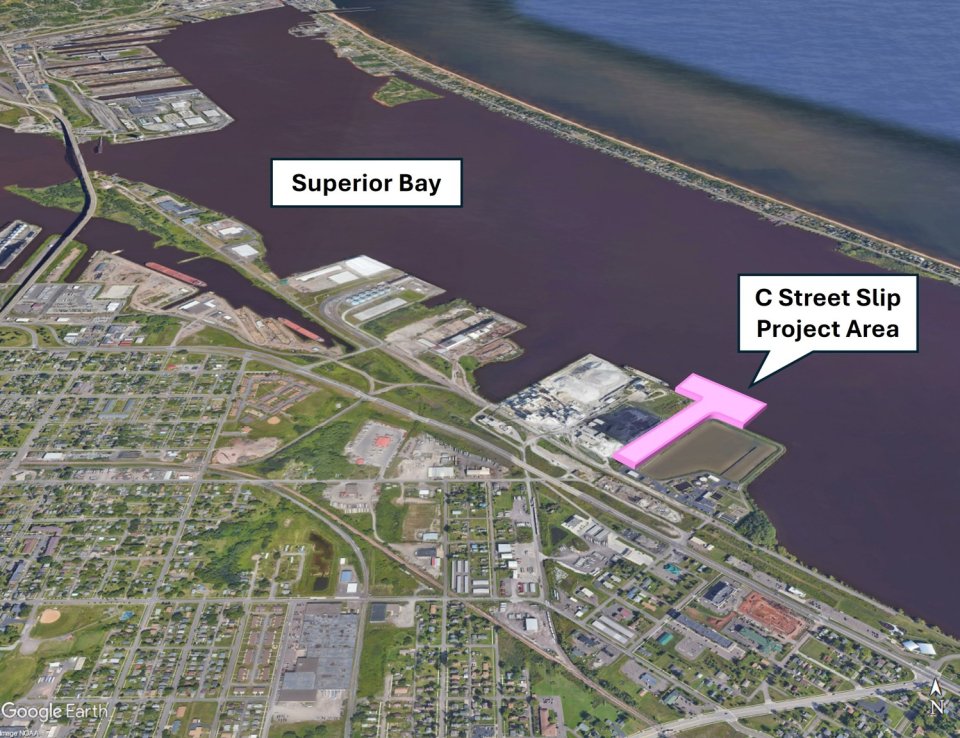
CHICAGO — Today, U.S. Environmental Protection Agency (EPA); Wisconsin Department of Natural Resources (DNR); and Superior Water, Light and Power Co. (SWL&P) awarded a $10.1 million contract to clean up sediments in a 12-acre slip in Superior Bay, Wisconsin, known as the C Street Slip. This project is the final phase of a $34 million project agreement to remove contaminated sediment and control sources of contamination in the St. Louis River Area of Concern.
“This milestone reflects years of commitment and collaboration among federal, state, local, and private partners to address legacy contamination in the St. Louis River Area of Concern,” said EPA Region 5 Administrator Anne Vogel. “Removing this long-standing source of pollution will create lasting benefits for the community by improving environmental quality, supporting recreation, and strengthening an important Great Lakes resource.”
“The EPA’s award of a construction contract for the C Street Slip reflects the trust and partnership among Superior Water Light and Power, EPA, and the State of Wisconsin, built over many years of collaboration to meet shared objectives to clean up the slip,” said Wisconsin DNR Secretary Karen Hyun. “The Wisconsin Department of Natural Resources is pleased to support this project and its contributions to correct legacy impacts in the St. Louis River and the broader efforts to protect and restore the Great Lakes.”
“This is what partnership looks like. Working alongside the EPA and the Wisconsin DNR, we can do more for the betterment of the planet than any one of us could accomplish alone,” said SWL&P President Rob Sandstrom. “This started as a project to clean up manufactured gas plant waste left from 125 years ago and because of this partnership, the EPA will be able to remove all sources of contamination from this slip. SWL&P customers, the Superior community, the St. Louis River estuary and Lake Superior all benefit from this collaboration.”
Historical industrial use of the St. Louis River, along with wastewater discharges, contaminated the river’s sediment with mercury, dioxins, polychlorinated biphenyls (PCBs), polycyclic aromatic hydrocarbons (PAHs), and other toxins.
Work on the C Street Slip project is expected to begin in 2027. Crews will remove approximately 23,000 cubic yards of contaminated sediment containing high levels of mercury and PAHs. The sediment will be dried and transported for disposal at an approved facility. Following sediment removal, a thin sand cover layer will be placed in the project area. Completion of this work will advance efforts to remove the St. Louis River AOC from the list of 23 AOCs remaining in the United States.
Background
The St. Louis River was designated as an Area of Concern under the Great Lakes Water Quality Agreement in 1987. An AOC is an area where significant environmental degradation has occurred. Draining 3,634 square miles of watershed and encompassing a 1,020 square-mile area, the St. Louis River is the second largest AOC in the United States.
EPA and partners—funded by the Great Lakes Restoration Initiative and non-federal contributions through project agreements under the Great Lakes Legacy Act—have remediated more than 1.9 million cubic yards of contaminated sediment and restored more than 1,000 acres of important habitat within the St. Louis River AOC. To date, 13 of the 19 sediment remediation projects and 17 of the 19 habitat restoration projects necessary to delist the AOC have been completed.
###
Follow EPA Region 5 on Instagram, X and visit our Facebook page. For more information about EPA Region 5, visit our website.