


'The Flow' and Other Newsletters, Articles, and Webinars
The Flow
Stay informed about the latest news from the Trash Free Waters program and our program partners with our electronic newsletter!
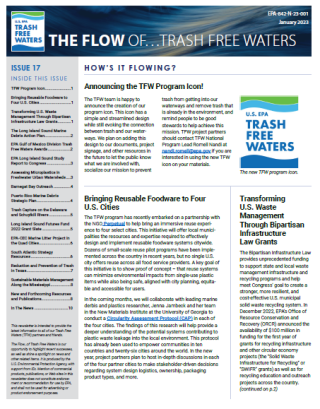
The Trash Free Waters program distributes ‘The Flow’ electronically to our many project partners and other interested stakeholders. ‘The Flow’ highlights important work that is happening at the local, state, national, and international levels related to trash reduction and prevention. Join our email list to receive 'The Flow' in your inbox.
Recent Issues
- The Flow of Trash Free Waters - November 2024 (pdf) Takeaways from a remote island trash expedition; launch of the Escaped Trash Risk Map; White House Council on Environmental Quality's Mobilizing Federal Action on Plastic Pollution; looking ahead to the Fifth Session of the INC; and more!
- The Flow of Trash Free Waters – April 2024 (pdf) Earth Month reflections; World Wildlife Fund Plastic Policy Summit; Trash Free Waters regional success stories; Plastic Free Parks TrashBlitz; PFAS drinking water regulation; Historic commitments to clean water in the US; and more!
- The Flow of Trash Free Waters - November 2023 (pdf) TFW 10-year anniversary; Draft National Strategy to Prevent Plastic Pollution; global plastic pollution treaty; Escaped Trash Assessment Protocol app; Chesapeake Bay Action Plastic Pollution Action Team; Trash Free Waters art contest; Marine Debris Foundation; new legislation introduced; and more!
- The Flow of Trash Free Waters - January 2023 (pdf) New program icon; reusable foodware to four cities; development of the Long Island Sound Marine Debris Action Plan & Puerto Rico Marine Debris Strategic Plan; assessments of urban watershed microplastics; development of microfibers and tire wear particles report; and more!
- The Flow of Trash Free Waters - May 2022 (pdf) Discussing a global plastic treaty; developing a Microfiber Report to Congress; release of the South Atlantic Strategy and Curbside Disposal Education Campaign Case Study; recent TFW projects in Alabama, Kansas, and New York; and more!
- The Flow of Trash Free Waters - October 2021 (pdf) Addressing marine litter domestically and abroad; ongoing stakeholder engagement initiatives; trash capture and the use of the Escaped Trash Assessment Protocol (ETAP); educating residents about proper curbside disposal behaviors; announcing the student winners of the AMA competition; and more!
- The Flow of Trash Free Waters - March 2021 (pdf)
- The Flow of Trash Free Waters - May 2020 (pdf)
- The Flow of Trash Free Waters - October 2019 (pdf)
- The Flow of Trash Free Waters - May 2019 (pdf)
- The Flow of Trash Free Waters - December 2018 (pdf)
- The Flow of Trash Free Waters - June 2018 (pdf)
- The Flow of Trash Free Waters – January 2018 (pdf)
- The Flow of Trash Free Waters – August 2017 (pdf)
- The Flow of Trash Free Waters – November 2016 (pdf)
- The Flow of Trash Free Waters – July 2016 (pdf)
- The Flow of Trash Free Waters - February 2016 (pdf)
- The Flow of Trash Free Waters - October 2015 (pdf)
- The Flow of Trash Free Waters - April 2015 (pdf)
- The Flow of Trash Free Waters - November 2014 (pdf)
'The Rapids' Email Archive
Click the links below to view past editions of The Rapids, EPA Trash Free Waters' monthly email update containing news and announcements, upcoming events, funding opportunities, and microplastics research updates.
If you would like to receive The Rapids in your inbox each month, join the EPA Trash Free Waters email list.
- The Rapids December 2024 (pdf)
- The Rapids November 2024 (pdf)
- The Rapids October 2024 (pdf)
- The Rapids September 2024 (pdf)
- The Rapids July 2024 (pdf)
- The Rapids June 2024 (pdf)
- The Rapids May 2024 (pdf)
- The Rapids April 2024 (pdf)
- The Rapids March 2024 (pdf)
- The Rapids February 2024 (pdf)
- The Rapids January 2024 (pdf)
- The Rapids December 2023 (pdf)
- The Rapids November 2023 (pdf)
- The Rapids October 2023 (pdf)
- The Rapids September 2023 (pdf)
- The Rapids August 2023 (pdf)
- The Rapids July 2023 (pdf)
- The Rapids June 2023 (pdf)
- The Rapids May 2023 (pdf)
- The Rapids December 2022 (pdf)
- The Rapids November 2022 (pdf)
- The Rapids October 2022 (pdf)
- The Rapids September 2022 (pdf)
- The Rapids August 2022 (pdf)
- The Rapids July 2022 (pdf)
- The Rapids June 2022 (pdf)
- The Rapids May 2022 (pdf)
- The Rapids April 2022 (pdf)
- The Rapids March 2022 (pdf)
- The Rapids February 2022 (pdf)
- The Rapids January 2022 (pdf)
- The Rapids December 2021 (pdf)
- The Rapids November 2021 (pdf)
- The Rapids October 2021 (pdf)
- The Rapids September 2021 (pdf)
- The Rapids August 2021 (pdf)
- The Rapids July 2021 (pdf)
- The Rapids June 2021 (pdf)
- The Rapids May 2021 (pdf)
- The Rapids April 2021 (pdf)
- The Rapids March 2021 (pdf)
- The Rapids February 2021 (pdf)
- The Rapids January 2021 (pdf)
- The Rapids December 2020 (pdf)
- The Rapids November 2020 (pdf)
- The Rapids October 2020 (pdf)
- The Rapids September 2020 (pdf)
- The Rapids August 2020 (pdf)
- The Rapids July 2020 (pdf)
- The Rapids June 2020 (pdf)
Trash-Free Waters Article Series
Click the links below to read articles in the Trash-Free Waters Article Series
The fifth article in the Trash Free Waters Article Series describes the negative impacts of trash on the environment and the especially notable impact of tourism at vacation destinations, as well as what tourists can do to help minimize these negative impacts.
Trash Free Waters On Any Timeline
This article provides a background on the sources and impacts of aquatic trash and includes a list of actions you can take to help keep trash out of our waterways.
What You Should Know About Microfiber Pollution
The second article in the EPA Trash Free Waters Article Series explains how our clothes are contributing to the plastic pollution problem. It also provides tips for how you can help reduce the flow of microfibers from your clothes into waterways.
Rethinking Plastic Packaging - How Can Innovation Help Solve the Plastic Waste Crisis?
The third article in the Trash Free Waters Article Series describes some of the innovative products and models that are being developed to reduce waste from plastic packaging. The article examines bio-based plastic materials, non-plastic packaging alternatives, and new reuse models.
Plastic Pollution in the Mississippi River - Regional Cooperation for a Transboundary Problem
This article examines the issue of plastic pollution in the Mississippi River Basin and describes an exciting new regional initiative to address the problem.
Trash-Free Waters Webinar Series
The goal of the Trash-Free Waters Webinar Series is to promote increased knowledge and understanding of existing TFW place-based efforts, innovative solutions to addressing marine litter, and the sources, distribution and impacts of plastics and microplastics in the environment. The featured presenters are experienced stakeholders and researchers in this field.
When available, upcoming webinars will appear directly below so please check back often.
Past Webinar Recordings
- Exploring the Escaped Trash Risk Map
- Microfibers are a Macro Issue: Interagency Report on Microfiber Pollution
- Plastics & Climate: Exploring What We Know, Impacts on Vulnerable Communities, and How to Solve the Problem
- You Are What You Eat (and Breathe): Exposure and Impacts of Nano- and Microplastics on Human Health
- The Voyage of 5 Gyres
- Extended Producer Responsibility - The Corporate Contribution to Keeping U.S. Waterways Clean
- Bioplastics - The Good, The Bad, & The Band-Aids
- Illegal Dumping - Best Practices to Address a Complex and Persistent Problem
- Using Clean Water Act Programs to Reduce Trash in Waterways
- Outreach and Education for Trash Free Waters – What Makes a Successful Campaign?
- Data Collection and Monitoring for Trash-Free Waterways
- Reuse Models as Part of the Solution to the Plastic Pollution Crisis
- Experiences and Lessons Learned from Trash Capture Projects
- Local Policies on Single-Use Plastics in the U.S.
- Trash Free Texas' "Adopt-A-Spot" Tool Webinar
- Brett Howell Cleanup Expedition to Henderson Island
- 2017 Plastics Webinar Series
Exploring the Escaped Trash Risk Map
Speakers:
- Romell Nandi, National Program Lead, EPA Trash Free Waters
- Jenna Jambeck, Ph.D., Professor of Environmental Engineering, University of Georgia
- Kathryn Youngblood, University of Georgia
- Kara Lavender Law, Ph.D., Research Professor of Oceanography, Sea Education Association
December 10, 2024
In October, EPA’s Trash Free Waters program unveiled the new Escaped Trash Risk Map. The map displays estimated escaped trash density in the United States at the 1km2 scale and shows where trash is at high risk of getting into waterways. The most common item types and the percentage breakdown of escaped trash materials are also available at the major river basin scale. In addition, microplastics data is displayed for select waterbodies. This webinar walks through the genesis of the map, how it was developed, how it can be used and how we plan to update it going forward.
- Webinar recording: https://www.youtube.com/watch?v=pQTQrg4TjXk
Microfibers are a Macro Issue: Interagency Report on Microfiber Pollution
Speakers:
- Carlie Herring, NOAA Marine Debris Program
- Nizanna Bathersfield, EPA Trash Free Waters Program
- Krystle Moody Wood, Materevolve
October 17, 2024
Microfiber pollution is an emerging issue of environmental concern due to the growing body of research uncovering the pervasiveness and potential ecological and human health impacts of microfibers in the environment. In July 2024, the Interagency Marine Debris Coordinating Committee released the Interagency Marine Debris Coordinating Committee Report on Microfiber Pollution – a Report to Congress mandated by Section 132 of the Save Our Seas 2.0 Act of 2020. This webinar will cover the details in the report as well as some of the ongoing efforts in the United States and beyond addressing microfiber pollution.
- Webinar recording: https://www.youtube.com/watch?v=-nLXh_u_H6g
Krystle Moody Wood Presentation - Solutions for Microfiber Pollution (pdf)
Plastics and Climate: Exploring What We Know, Impacts on Vulnerable Communities, and How to Solve the Problem
Speakers:
- Alice Zhu, PhD Candidate & Vanier Scholar at the University of Toronto, Co-Founder of Plastics & Climate Project
- Dr. John M. Doherty, Science and Policy Analyst at Environmental Law Institute
- Margaret Spring, Chief Conservation and Science Officer at Monterey Bay Aquarium
April 4, 2024
From production and transport to consumption and disposal, plastics have a profound impact on our environment, including our climate. During this webinar, three expert panelists provide information on the effects of plastic consumption and production on climate change and answer questions about this serious problem. Explore the nature and scale of the plastic problem, hear about policy options to mitigate its effects, and learn about the disproportionate burden placed on vulnerable populations in this edition of the Trash Free Waters webinar series.
- Webinar recording: https://www.youtube.com/watch?v=KTfdmuVoc2Y
Alice Zhu Presentation - Plastics and Climate Overview (pdf)
John Doherty, PhD Presentation - Policy Tools (pdf)
Margaret Spring Presentation - Vulnerable Communities and Technical Solutions (pdf)
You Are What You Eat (and Breathe): Exposure and Impacts of Nano- and Microplastics on Human Health
Speakers:
- Dr. Charlie Rolsky, Executive Director, Shaw Institute
- Dr. Todd Gouin, Researcher at TG Environmental Research, Primary Author of the World Health Organization report, "Dietary and inhalation exposure to nano- and microplastic particles and potential implications for human health"
- Dr. Scott Coffin, Research Scientist and Subject-Matter Expert for Microplastics, California State Water Resources Control Board
November 30, 2023
Plastic waste of varying shapes, sizes and polymers is found throughout our environment and is one of the most prevalent types of solid waste materials found in our oceans and waterways. There are still many questions regarding the specific threat of micro- and nanoplastics to human health and our environment. Microplastics are typically defined as being less than five millimeters in length and nanoplastics are even smaller at 100 nanometers or less in length. As an emerging field of study, their impact on human health is still shrouded in a lot of uncertainty.
The three speakers on this webinar presented on what we know and what we do not know about our exposure to micro- and nanoplastics and their impacts on our health.
- Webinar Recording: https://www.youtube.com/watch?v=JjYnf3yRXHQ
Scott Coffin, PhD presentation – Microplastics Monitoring in Drinking Water (pdf)
The Voyage of 5 Gyres
Speakers:
- Dr. Marcus Eriksen, Co-founder and Scientist, 5Gyres Institute
- Anna Cummins, Co-founder and Executive Director, 5Gyres Institute
June 13, 2023
On this webinar, the Trash Free Waters program hosted a conversation with Dr. Marcus Eriksen and Anna Cummins, co-founders of the non-governmental organization 5Gyres Institute and renowned experts and advocates for a world free of plastic pollution. Learn about their journey from awareness to advocacy, the synergies and challenges between their passion for family and cause, and their vision for how to create a healthier world for current and future generations.
- Webinar Recording: https://youtu.be/H2NnIg7UCss
Extended Producer Responsibility - The Corporate Contribution to Keeping U.S. Waterways Clean
Speakers:
- Scott Cassel, CEO & Founder, Product Stewardship Institute
- Nicole Grohoski, Maine State Senator, Maine Senate District 7
- Kelly McBee, Circular Economy Sr. Coordinator, As You Sow
February 15, 2023
There are many strategies to consider for effectively preventing trash from entering waterways or removing it once it is there. Positively changing consumer behavior, expanding recycling infrastructure, installing trash capture devices in waterways or as part of stormwater conveyance systems, and more constitute parts of the solution space - but in and of themselves, these solutions may not be adequate to keep waterways clean. A potentially impactful step that is now being considered and increasingly implemented throughout the United States is Extended Producer Responsibility (EPR). EPR is a policy to ensure that the private sector bear significant responsibility for the environmental impacts of their product throughout the product life cycle.
These expert panelists provide context to EPR policies and development at national, state, and corporate levels.
- Webinar Recording: https://youtu.be/R5SvHGjzAig
Bioplastics - The Good, The Bad, & The Band-Aids
Speakers:
- Jason Locklin, Founder of New Materials Institute at the University of Georgia
- Rhodes Yepsen, Executive Director of the Biodegradable Products Institute
- Jamie Brown, Zero Waste Specialist at EcoProducts
October 27, 2022
Bioplastics have been circulated in consumer markets for decades, with the promise of reducing plastic waste, greenhouse gas emissions, and general fossil fuel use and extraction. Plastic pollution (macro and micro) has proven to be an incredible challenge for our planet, making innovations such as these necessary for future sustainability in waste management. While bioplastics and their promises have delivered in many regards, their composition and current processing infrastructure may not be quite at the caliber we would hope for in 2022.
This panel of experts will discuss the pros and cons associated with modern bioplastics, behavior change and behavior perpetuation that has come about from bioplastic use, and the future of bioplastic innovations in consumer markets.
- Webinar Recording: https://youtu.be/gRN9rs84kls
Illegal Dumping - Best Practices to Address a Complex and Persistent Problem
Speakers:
- Dr. Calvin Lakhan, PhD, Professor at York University, Corresponding author of the report "Best Practices in Addressing Illegal Dumping of Durable Waste - A Guide for Policy Makers"
- Pete Flood, Executive Director, Waste Management District, Enforcement Manager, City of Louisville Department of Public Works
- Erin Armstrong, Senior Policy Advisor, Alameda County, CA Supervisor Nate Miley District 4
July 13, 2022
Illegal dumping, which broadly refers to the "disposal of waste in an unpermitted area," is a persistent problem that can have significant impacts on public health and the environment. Though illegal dumping occurs in many regions across the U.S., the causes and consequences vary widely. This webinar provides an overview of illegal dumping, what we know about the underlying causes, and the challenges that communities face in responding to and preventing illegally dumped waste. The speakers shared insights and lessons learned from their experiences researching the issue or implementing programs to mitigate illegal dumping.
- Webinar Recording: https://youtu.be/gv1Z_tFIPJA
Speakers:
- Jillian Adair, Standards and TMDLs Section, Water Division, EPA Region 3
- Elizabeth Ottinger, Permits Section, Water Division, EPA Region 3
- Mark Cameron, Section Chief, Watershed Planning and Partnerships, Baltimore City Department of Public Works
May 26, 2022
The Clean Water Act (CWA) is the primary federal law governing the protection of the nation’s waters. The CWA established several programs that states and municipalities can use to reduce the amount of trash loadings into waterways. In this webinar, attendees can learn how some states in the Mid-Atlantic region are addressing trash pollution using CWA programs, including the Water Quality Standards, Total Maximum Daily Load (TMDL), Nonpoint Source, and National Pollutant Discharge Elimination System programs. Speakers discussed the opportunities and limitations associated with various programmatic approaches to addressing trash loadings into waterways.
- Webinar Recording: https://youtu.be/0jUrpA9arpM
Outreach and Education for Trash Free Waters – What Makes a Successful Campaign?
Speakers:
- Ellie Moss, Founder and Principal at Moss and Mollusk Consulting and primary author of “Reducing Plastic Pollution: Campaigns That Work”
- Katie Register, Executive Director of Clean Virginia Waterways of Longwood University
- Adam Lindquist, Director of the Waterfront Partnership of Baltimore’s Healthy Harbor Initiative
January 20, 2022
Changing the way people consume products and dispose of their waste is an important part of the solution to the plastic pollution crisis. But when do outreach campaigns and education efforts actually result in the behavior changes necessary to prevent plastic and other types of trash from getting into our waterways? In this EPA Trash Free Waters Program webinar, three expert speakers discussed lessons learned and best practices for outreach campaigns aimed at preventing aquatic trash. The speakers provided practical information on how to craft an effective anti-littering or source reduction outreach campaign and discussed common barriers to achieving desired behavior changes and strategies for overcoming these barriers.
- Webinar Recording: https://youtu.be/wUYccQeRa4E
Data Collection and Monitoring for Trash-Free Waterways
Speakers:
- Dr. Pinar Balci, Assistant Commissioner, NYC Department of Environmental Protection, Bureau of Environmental Planning and Analysis
- Randy Hartmann, Senior Director of Affiliate Operations, Keep America Beautiful
- Sarah Kollar, Outreach Manager, International Coastal Cleanup, Trash Free Seas Program, Ocean Conservancy
September 23, 2021
When it comes to trash in waterways, it’s hard to manage what you can’t measure. Data on the location, amount, and types of trash polluting the environment can have a wide range of benefits. It has the potential to increase public awareness, guide policy solutions, and improve the effectiveness of solid waste and stormwater management. However, trash is a complex pollutant and obtaining useful data on trash in waterways is fraught with challenges. The sixth installment in the U.S. Environmental Protection Agency’s (EPA) Trash Free Waters Webinar Series, Data Collection and Monitoring for Trash-Free Waterways, examined the benefits and challenges associated with litter data collection and monitoring.
During the webinar, speakers described three data collection and monitoring efforts that are each making an impact in different ways. Speakers provided local, national, and global perspectives on methods for collecting and analyzing trash data and the major challenges for obtaining and utilizing data.
- Webinar Recording: https://youtu.be/RR4s_r39p_A
Reuse Models as Part of the Solution to the Plastic Pollution Crisis
Speakers:
- Crystal Dreisbach, Executive Director of Don't Waste Durham and Founder of Durham GreenToGo
- Annika Greve, Business Development Director (North America), Loop
- Miriam Gordon, Policy Director, UPSTREAM Solutions
March 11, 2021
Disposable plastic packaging is a major source of the plastic waste that is accumulating at alarming rates in marine and freshwater environments. About 40% of all plastic produced globally is used for packaging. Reuse and refill models are creating new opportunities for consumers to reduce the amount of waste they generate by making it easier to purchase goods in reusable containers. In this webinar, speakers describe different types of reuse and refill models and discuss why reuse can be an important part of the solution to the plastic pollution problem both globally and locally. Speakers will also discuss the major challenges and opportunities for launching, maintaining, and scaling up reuse systems.
- Webinar Recording: https://www.youtube.com/watch?v=XGhUFwSD-z8
Experiences and Lessons Learned from Trash Capture Projects
Speakers:
- Darryl Haddock, Education Director, West Atlanta Watershed Alliance
- Matt Robinson, Environmental Protection Specialist, Washington DC Department of Energy & Environment
- Chris Sommers, Vice President-Project Management, EOA Inc.
November 5, 2020
- Webinar Recording: https://youtu.be/bIPOsyVXTr8
Local Policies on Single-Use Plastics in the U.S.
Speakers:
- Josh Kelly, Materials Management Section Chief - Vermont Agency of Natural Resources
- Kara Mertz, Sustainability Manager - City of Boulder, Colorado
- Jennie Romer, Esq., Legal Associate - Plastic Pollution Initiative, Surfrider Foundation
- Tommy Wells, Director -DC Department of Energy & Environment (DOEE)
July 9, 2020
- Webinar Recording: https://youtu.be/I7EBYYg_tWQ
Lessons Learned from the Trash Free Texas Adopt-A-Spot Program
Speakers:
- Project champions from the City of Fort Worth, Keep Texas Beautiful, and Texas State University
April 15, 2020
- Webinar Recording: https://youtu.be/qWUykQpezcE
Brett Howell Cleanup Expedition to Henderson Island
Speaker:
- Brett Howell, Conservationist
December 11, 2019
- Webinar Recording: https://youtu.be/JCB4qJ92NJ4
2017 Plastics Webinar Series
Webinar #1: Impacts of Plastics in the Aquatic Environment
Speaker: Dr. Chelsea Rochman, University of Toronto
January 31, 2017
In this webinar, Dr. Rochman provides an overview of plastics sources, impacts and solutions, taking both ecological and human health concerns into account, and discusses major gaps in our current understanding of plastics pollution.
Resources Referenced in the Webinar
- United Nations Secretariat of the Convention on Biological Diversity: Marine Debris: Understanding, Preventing and Mitigating the Significant Adverse Impacts on Marine and Coastal Biodiversity (PDF)(81 pp, 905 K, About PDF)
- Joint Group of Experts on the Scientific Aspects of Marine Environmental Protection: Sources, Fate and Effects of Microplastics in the Marine Environment: Part 2 of a Global Assessment
- GRID-Arendal: Marine Litter Vital Graphics
Webinar #2: Sources and Distribution of Microplastics in the Environment
Speaker: Dr. Kara Lavender Law
February 28, 2017
In this webinar, Dr. Law provides an overview of microplastics sources and distribution including estimates of the global distribution of microplastics and their potential risks, and considers some practical solutions to reducing microplastics in the environment.
Resource Referenced in the Webinar
- Sea of Opportunity: Supply Chain Investments to Address Marine Plastic Pollution (includes "last chance capture")
Webinar #3: Contaminants Associated with Microplastics
Speaker: Dr. Bart Koelmans
April 18, 2017
In this webinar, Dr. Koelmans provides an overview of how environmental contaminants interact with microplastics and whether microplastics act as carriers for these contaminants, including results from mathematical calculations and laboratory studies.
Webinar #4: Risk Assessment of Plastics and Microplastics
Speaker: Dr. Denise Hardesty
April 25, 2017
In this webinar, Dr. Hardesty provides an overview of different approaches to estimate and understand the potential impacts of plastics and microplastics, including assessments for seabirds and sea turtles, as well as research that she and her colleagues have done to understand marine litter sources in Australia on a national scale.
Resources Referenced in the Webinar
- Surowiecki, James. The Wisdom of Crowds. New York: Anchor Books, 2005
- Dr. Hardesty's Publications (scroll down page to "Publications").
Webinar #5: Plastics in the Deep Sea
Speaker: Dr. Lucy Woodall
May 30, 2017
In this webinar, Dr. Lucy Woodall discusses the latest research that she and others are conducting to understand the presence and distribution of plastics in the deep sea, and how this plastic might impact marine life.
Resources Referenced in the Webinar
- Litterbase
- The Deep Sea is a Major Sink for Microplastic Debris
- Woodall LC, Sanchez-Vidal A, Canals M, Paterson GLJ, Coppock R, Sleigh V, Calafat A, Rogers AD, Narayanaswamy B and Thomson R (2014). Royal Society Open Science, 1: 140317.
- Plastic Microfibre Ingestion by Deep-Sea Organisms
Taylor ML, Gwinnett C, Robinson LF and Woodall LC (2016). Scientific Reports, 6: 33997.
Webinar #6: Waste Management of Plastics and Upstream Solutions
Speaker: Dr. Jenna Jambeck
June 27, 2017
In this webinar, Dr. Jenna Jambeck discusses her research on global waste management and mismanagement of plastics as well as potential solutions to reduce and prevent the release of plastic waste into the environment.
Resources Referenced in the Webinar
Webinar #7: Preventing Marine Debris through Outreach and Education
Speaker: Krista Stegemann
July 25, 2017
In this webinar, Krista Stegemann discusses NOAA-funded projects that aim to prevent marine debris through outreach and education, as well as strategies and educational resources for marine debris communication.
Resource Referenced in the Webinar
Webinar #8: Reducing Plastic Pollution with Better Products and Policies
Speaker: Dr. Jason McDevitt
August 29, 2017
Dr. Jason McDevitt discusses potential replacements for plastic products and how we can improve the ways in which we design materials and products to minimize their environmental impacts.