
U.S. flag

An official website of the United States government

Here’s how you know

Dot gov

Official websites use .gov
A .gov website belongs to an official government organization in the United States.

HTTPS

Secure .gov websites use HTTPS
A lock (LockA locked padlock) or https:// means you’ve safely connected to the .gov website. Share sensitive information only on official, secure websites.

    • Environmental Topics
    • Air
    • Bed Bugs
    • Chemicals, Toxics, and Pesticide
    • Emergency Response
    • Environmental Information by Location
    • Health
    • Land, Waste, and Cleanup
    • Lead
    • Mold
    • Radon
    • Research
    • Science Topics
    • Water Topics
    • A-Z Topic Index
    • Laws & Regulations
    • By Business Sector
    • By Topic
    • Compliance
    • Enforcement
    • Guidance
    • Laws and Executive Orders
    • Regulations
    • Report a Violation
    • Environmental Violations
    • Fraud, Waste or Abuse
    • About EPA
    • Our Mission and What We Do
    • Headquarters Offices
    • Regional Offices
    • Labs and Research Centers
    • Planning, Budget, and Results
    • Organization Chart
    • EPA History

Breadcrumb

  1. Home
  2. Envirofacts

UV Index Overview

Envirofacts Home | SunWise UV Index Mobile App | Topic Searches  | Data Downloads | SDWIS Search | TRI Search | Other System Searches | Multisystem Search | About the Data |  Widgets | Web Services | Other Datasets
UV Banner
UV icon

UV Index overview

The ozone layer shields the Earth from harmful ultraviolet (UV) radiation. Ozone depletion, as well as seasonal and weather variations, cause different amounts of UV radiation to reach the Earth at any given time. The UV Index predicts ultraviolet radiation levels on a 1–11+ scale, helping people determine appropriate sun-protective behaviors. Several fact sheets explain the UV Index and steps you can take to minimize the risks from overexposure to the sun’s rays. The website will also display a UV Alert when the level of solar UV radiation is predicted to be unusually high and the risk of overexposure is greater.

Some exposure to sunlight can be enjoyable; however, too much can be dangerous. Overexposure to the sun’s UV radiation can cause immediate effects such as sunburn and long-term problems such as skin cancer and cataracts. The UV Index provides important information to help you plan outdoor activities and prevent overexposure.

The UV Index provides a daily forecast of the expected risk of overexposure to the sun. The Index predicts UV intensity levels on a scale of 1 to 11+, where 1 indicates minimal risk and 11+ means very high risk. Calculated on a next-day basis for dozens of cities across the United States, the UV Index takes into account clouds and other local conditions that affect the amount of UV radiation reaching the ground.
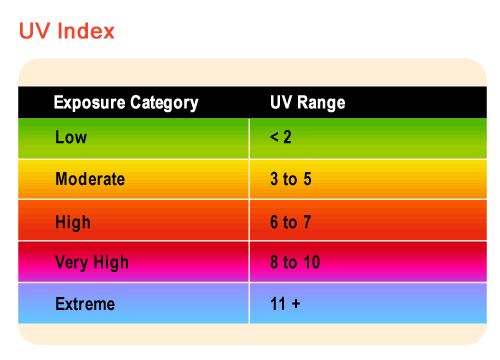
UV Index scale
UV Index scale.

Learn more about UV Index risk levels.

Sun safety tips

By taking a few simple precautions, you can greatly reduce your risk of sun-related illnesses:

  • Limit your time in the sun between 10:00 a.m. and 4:00 p.m.
  • Whenever possible, seek shade.
  • Use a broad-spectrum sunscreen with a Sun Protection Factor (SPF) of at least 30.
  • Wear a wide-brimmed hat and, when possible, tightly woven, full-length clothing.
  • Wear UV-protective sunglasses.
  • Avoid sunlamps and tanning salons.
  • Check the UV Index daily.

While you should always take precautions against overexposure to the sun, take special care to adopt these safeguards when the UV Index predicts moderate levels or higher. Watch for UV Index reports in local newspapers and on television. For more information, visit EPA’s Sun Safety pages and the National Weather Service UV Index pages.

UV Index Links

  • Overview
  • Search
  • Data Source
  • UV Index Scale
  • Learn About the UV Index
  • Contact Us

System Data Searches

Envirofacts

  • Multisystem Search
  • BR Search
  • GHG Search
  • GHG Query Builder
  • ICIS Search
  • ICIS Air Pollution Search
  • RADNET Radiation Search
  • RadNet Query Builder
  • RCRAInfo Search
  • NEI Search
  • NGGS Search
  • SDWIS Search
  • SEMS Search
  • UV Index Search

Toxic Release Inventory (TRI)

  • TRI Explorer
  • TRI Search
  • Form R Search
  • Form R & A Download
  • EZ Search
  • Customized Search
  • Pollution Prevention

Facility Registry Service (FRS) Query

  • FRS Query
  • FRS Query Builder
  • FRS Organization Query Form

Map of Cleanups in My Community

ECHO

SRS Search

Other Sites of Interest

  • Geospatial Download
  • EnviroMapper
  • MyEnvironment

Envirofacts

  • Multisystem Search
  • Search Tools
  • Maps & Visualizations
  • Data & Developer Services
  • TRI Search
Contact Us About Envirofacts
Contact Us About Envirofacts to ask a question, provide feedback, or report a problem.
Last updated on December 12, 2025
  • Assistance
  • Spanish
  • Arabic
  • Chinese (simplified)
  • Chinese (traditional)
  • French
  • Haitian Creole
  • Korean
  • Portuguese
  • Russian
  • Tagalog
  • Vietnamese
United States Environmental Protection Agency

Discover.

  • Accessibility Statement
  • Budget & Performance
  • Contracting
  • EPA www Web Snapshot
  • Grants
  • No FEAR Act Data
  • Plain Writing
  • Privacy and Security Notice

Connect.

  • Data
  • Inspector General
  • Jobs
  • Newsroom
  • Regulations.gov
  • Subscribe
  • USA.gov
  • White House

Ask.

  • Contact EPA
  • EPA Disclaimers
  • Hotlines
  • FOIA Requests
  • Frequent Questions
  • Site Feedback

Follow.