


Overview of the National Estuary Program

Cover photo credit: Mark Lagrange.
On this page:
About the National Estuary Program
- EPA's NEP is a non-regulatory program that improves the waters, habitats and living resources of 28 estuaries across the country.
- Each NEP develops and implements a long-term plan (referred to as a Comprehensive Conservation and Management Plan (CCMP)) based on local priorities to guide their efforts.
- The NEPs involve community members in the decision-making process.
Overview
The NEP is a non-regulatory program established by Congress under section 320 of the Clean Water Act (CWA) in 1987 to pioneer a broad and innovative approach to respond to threats to estuaries.
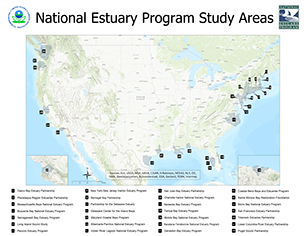
The National Estuary Program (NEP) is an EPA place-based program to protect and restore the water quality and ecological integrity of estuaries of national significance. Currently, 28 estuaries located along the Atlantic, Gulf, and Pacific coasts and in Puerto Rico are designated as estuaries of national significance. These NEPs were selected after national solicitations seeking nominations to the program and are located in a variety of institutional settings, including state and local agencies, universities and individual nonprofits. In overseeing and managing the national program, EPA provides annual funding, national guidance and technical assistance to the local NEPs.
In keeping with section 320 of the CWA, the 28 NEPs develop and implement Comprehensive Conservation and Management Plans (CCMPs), which are long-term plans that contain sustained actions to protect and restore water quality and living resources. CCMPs identify a study area or geographic boundary within which the plan is focused and actions are implemented under Section 320 of the Clean Water Act. The challenges, priorities, and actions in the CCMP reflect the study area and are determined by local, city, state, federal, private and non-profit stakeholders.
Each NEP has a Management Conference (MC) that consists of diverse stakeholders and uses a collaborative, consensus-building approach to implement the CCMP. Moreover, each MC ensures that the CCMP is uniquely tailored to the local environmental conditions and is based on local input, thereby supporting local priorities.
For more information on CCMPs and other lessons learned in conducted watershed planning for National Estuary Programs, please see the Community-Based Watershed Management Handbook.

The National Estuary Program Designation Process
When the EPA periodically calls for nominations to bring on new NEPs, state governors in which the estuary and its watershed are located submit the nomination to the EPA Administrator. The EPA considers available funding along with unaddressed new geographic areas (e.g., states without NEPs) and new environmental issues before seeking a broad call for nominations. The last call was in 1995.
When calling for nominations, the EPA conducts a public, fair, and transparent competitive process. This enables the agency to consistently evaluate how a nominated estuary would offer opportunities to advance the national program by bringing innovative approaches, covering different geographic areas, addressing new or challenging environmental issues meeting both local and national Clean Water Act priorities, and addressing other factors. Nominations begin formally when the governor(s) of the state or states in which the study area is located submits a package to the EPA Administrator based on specific critical elements outlined in the call for nominations. Critical elements of the nomination include:
- demonstrating significant environmental need to protect and restore the nominated estuary;
- committing to fully develop a National Estuary Program consistent with Section 320 of the Clean Water Act;
- committing resources to support a program, if selected, with long-term matching funds and other resources;
- identifying a lead entity to manage the program;
- demonstrating strong state and local long-term support from a wide range of partners and stakeholders;
- engaging in the development and implementation of an EPA approved Comprehensive Conservation and Management Plan (CCMP).
Estuaries of National Significance selections are approved and announced by the EPA Administrator, which enables eligibility for EPA funding to support the development and implementation of the CCMPs. Please note this is for informational purposes only
On March 25, 2026, Assistant Administrator of Water Kramer, on behalf of Administrator Zeldin, invited the Florida Governor to submit requisite information to support the designation of Pensacola and Perdido Bays as an Estuary of National Significance in response to the Pensacola and Perdido Bays Estuary of National Significance Act of 2024 (Public Law 118-152) that amended Clean Water Act Section 320 (33 U.S.C. 1330).