Superfund Remedial Annual Accomplishments Metrics Fiscal Year 2025
Fiscal Year 2025 Report
EPA’s Superfund program tracks the following measures on an annual basis to highlight the program’s progress in cleaning up sites and supporting their return to beneficial use.
On this page:
- Superfund Technical Assistance Services for Communities (TASC) nationwide support
- Protecting communities' health and ecosystems
- Safeguarding communities from imminent threats
- Preparing for future cleanup efforts
- Funding Superfund work
- Superfund community involvement
- Conducting construction work
- Completing construction work
- Ensuring long-term protection
- Superfund Sites "deleted" from the National Priorities List after successful cleanups
- Optimizing Superfund work to increase efficiency
- EPA funds state and Tribal Superfund work
- Supporting future use of Superfund sites
Superfund Technical Assistance Services for Communities (TASC) nationwide support
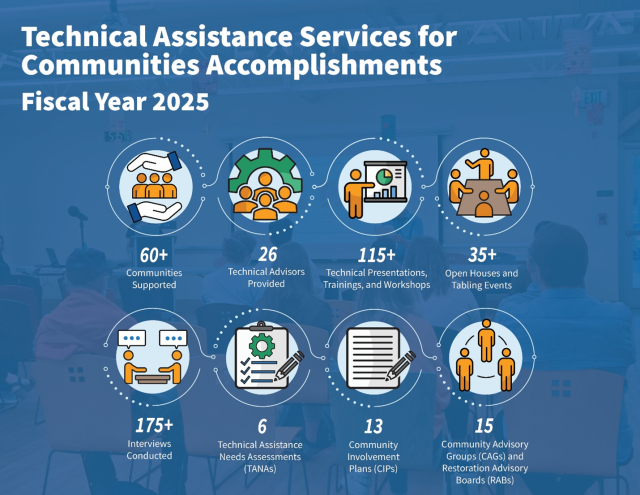
To help communities understand environmental issues and more substantively participate in the cleanup decision-making process, TASC continued to expand its work in over 60 communities. TASC requests from communities are coordinated through regional offices and serve to meet the communities where they are, providing them with a basis of Superfund knowledge and understanding of site-specific technical information. This year, the TASC program provided a technical advisor at twenty-six Superfund sites, where they delivered more than 115 plain language technical presentations, trainings, and workshops to community members. Additionally, TASC supported community outreach at more than 35 open houses and tabling events. TASC facilitated over 175 interviews with community members that supported the development of six Technical Assistance Needs Assessments and 13 Community Involvement Plans. TASC also helped support 15 community advisory groups and restoration advisory boards.
Protecting communities' health and ecosystems
EPA completed actions that brought human exposures under control at an additional 10 Superfund sites, bringing the cumulative total at the end of fiscal year 2025 to 1,505 sites. EPA also controlled the migration of contaminated groundwater through engineered remedies or natural processes at an additional 9 sites, bringing the cumulative total to 1,191 sites.
Safeguarding communities from imminent threats
In fiscal year 2025, EPA completed 195 removal actions to address contamination that posed imminent and substantial threats to human health and the environment.
Preparing for future cleanup efforts
- EPA completed 553 remedial site assessments, for a cumulative total of 55,630. These assessments determine whether a release warrants additional actions by EPA or can be referred to some other authority.
- EPA placed three sites on and proposed one site to the National Priorities List, the list of sites of national priority among the known releases or threatened releases of hazardous substances, pollutants, or contaminants throughout the United States and its territories.
- At the end of fiscal year 2025, the list had 38 proposed, 1343 final and 459 deleted sites.
- EPA selected 10 cleanup remedies and updated 32 cleanup plans.
- There are currently 51 Superfund alternative approach agreements still in active remediation, and there are 18 sites that have “alternative” agreements that are construction complete.
Funding Superfund work
Special accounts
In fiscal year 2025, EPA disbursed or obligated about $268.4 million, including reclassifications, for site-specific work across Superfund response programs, from special accounts established with funds received through potentially responsible party settlements. Cumulatively, as of the end of fiscal year 2025, approximately $6.1 billion has been disbursed or obligated for Superfund cleanups from these accounts.
Pre-construction
In fiscal year 2025, EPA obligated over $308 million to conduct and oversee pre-construction site work, such as site assessments and investigations, selection and design of cleanup plans, and support for state, Tribal, community involvement and other activities—from available congressional appropriations, Superfund tax funds, and special accounts.
Construction funding
In fiscal year 2025, EPA obligated over $766 million for construction and post-construction projects from funds provided by the Infrastructure Investment and Jobs Act of 2021 (IIJA), Superfund taxes, congressional appropriations, states, and special accounts.
Spotlight on enforcement
EPA’s Superfund enforcement program has enabled thousands of site investigations and cleanups. It has required viable responsible parties to either conduct that work and or pay for the cleanups at Superfund sites, which preserves Superfund tax dollars for use at sites where there are no viable liable parties. The work of the enforcement program also supports the Agency’s efforts to addresses liability concerns of parties willing to clean up a site, which promotes reuse of contaminated property. Overall, the Superfund enforcement program helps ensure clean air, land, and water for every American while making a visible difference in communities across the country.
In FY 2025, through enforcement instruments, EPA obtained $714.3 million in commitments from responsible parties and third parties to clean up Superfund sites or to pay for future work. EPA also recovered more than $174.1 million for past costs incurred by EPA to conduct cleanup activities. Additionally, EPA billed parties approximately $94.5 million of EPA’s costs for overseeing their cleanup work. With the addition of this fiscal year’s accomplishments, the Superfund enforcement program, since its beginning in 1980, has obtained approximately $52.5 billion in responsible party and third-party commitments for site investigation and cleanup and reimbursement of EPA’s costs spent in cleaning up sites.
Superfund community involvement
Superfund community involvement is the process of engaging with communities affected by Superfund sites as key partners in the cleanup decision-making process. Superfund community involvement provides opportunities for the affected community to work directly with the EPA to ensure that cleanup decisions are considerate of the community’s needs and priorities.
In FY 2025, EPA Superfund site teams provided outreach to 443,798 people, held or attended 482 public meetings, conducted 674 interviews with community members living near Superfund sites and distributed 545 fact sheets, mailings, postcards, advertisements and newsletters. Community Involvement data is complete through June 2025 and will be updated as further data is received.
Conducting construction work
EPA and other project leads started 69 new remedial construction projects, including 27 government-led projects, 20 projects led by Potentially Responsible Parties, and 22 federal facility-led projects.
EPA and other project leads conducted construction or provided oversight at 546 remedial construction projects started in prior fiscal years.
Completing construction work
In fiscal year 2025, EPA and other project leads completed 72 remedial construction projects.
“Construction completion” is a milestone that indicates all physical construction required for the cleanup of the entire site has been completed (even though final cleanup levels may not have been achieved). For example, a groundwater treatment system has been constructed though it may need to operate for several more years for all contaminants to be removed from the groundwater.
In fiscal year 2025, all physical construction required for the cleanup of the entire site was completed at one site.
Ensuring long-term protection
EPA conducted 302 five-year reviews, including 32 at federal facility sites, to ensure that remedies built at these sites continue to protect communities.
Superfund Sites "deleted" from the National Priorities List after successful cleanups
Deletion from the NPL announces to communities and signals to potential developers and financial institutions that cleanup is complete. A deletion helps the community move forward and is necessary for a site to be eligible for Brownfields grants that help revitalize communities and promote economic growth.
In fiscal year 2025, EPA deleted one full site and parts of three more sites. In total, EPA has deleted 459 sites from the NPL and has made 159 partial deletions at 118 NPL sites (some sites have multiple partial deletions).
Optimizing Superfund work to increase efficiency
Through Superfund’s optimization program, teams of independent technical experts identify and support opportunities to improve the effectiveness and cost efficiency of Superfund remedies. In fiscal year 2025, Superfund completed 43 optimization evaluation and support projects. The optimization program has completed 557 studies at 385 sites since the program’s inception in fiscal year 1999. The optimization of remedies typically yields benefits in terms of cost savings, improved effectiveness, and improved timelines of completion that greatly exceed the costs of optimization itself.
EPA funds state and Tribal Superfund work
In partnership with states and Tribes and through cooperative agreements, EPA provides states and Tribes with funding to conduct work under the Superfund program, including site assessment, investigations, remedial action, review of remedy decision documents and enforcement actions. In fiscal year 2025, EPA provided approximately $60.8 million to states and $7.4 million to Tribes to conduct activities at NPL sites, and to support the Superfund program. States and Tribes play a significant role in identifying and assessing sites to determine the most appropriate cleanup program to address the site. In fiscal year 2025, states developed 341 of the 553 Superfund remedial site assessments across 37 states and Tribes completed 13 remedial site assessments on Tribal lands.
Supporting future use of Superfund sites
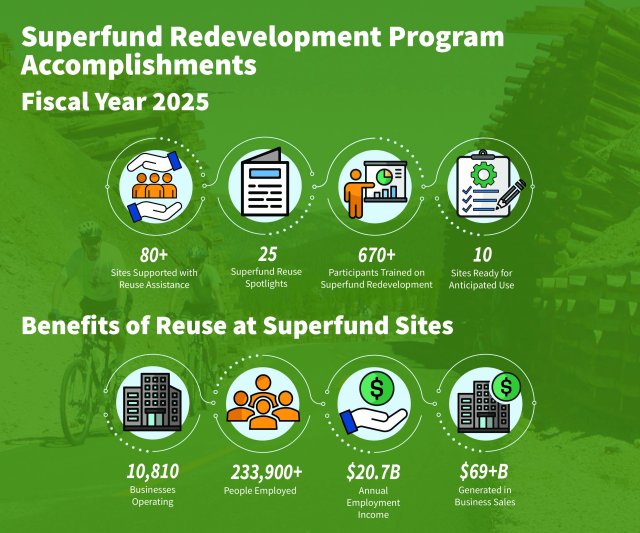
EPA's Superfund Redevelopment Program (SRP) works with communities nationwide to realize the reuse and redevelopment potential of Superfund sites, transforming formerly contaminated lands into valuable community resources. SRP provided reuse planning assistance at more than 80 Superfund sites in 2025. This assistance is coordinated through EPA’s regional redevelopment coordinators to help site teams and communities remove barriers to productive reuse and ensure that future uses are well aligned with the cleanup process. SRP also held training on Superfund redevelopment topics for more than 670 participants and developed 25 spotlights, including case studies and videos, highlighting successful reuse. 10 sites were made sitewide ready for anticipated use, which means all aspects of the cleanup are in place to support reuse. New information has also been added to the Superfund Redevelopment Mapper to help people explore potential reuse opportunities.
SRP also measures the beneficial economic effects of reuse at Superfund sites. Today, Superfund sites support new and ongoing uses nationwide. SRP has collected data on more than 10,810 businesses at 739 non-federal Superfund sites. In Fiscal Year 2025, these businesses generated $69+ billion in sales and employed more than 233,900 people who earned a combined income of $20.7 billion. Over the last 15 years (2011-2025), these businesses’ ongoing operations have generated $868+ billion (inflation adjusted) in sales, which is more than 38 times the $22.8 billion (inflation adjusted) EPA has spent cumulatively at these sites for cleanup.