U.S. flag

An official website of the United States government

Here’s how you know

Dot gov

Official websites use .gov
A .gov website belongs to an official government organization in the United States.

HTTPS

Secure .gov websites use HTTPS
A lock (LockA locked padlock) or https:// means you’ve safely connected to the .gov website. Share sensitive information only on official, secure websites.

    • Environmental Topics
    • Air
    • Bed Bugs
    • Chemicals, Toxics, and Pesticide
    • Emergency Response
    • Environmental Information by Location
    • Health
    • Land, Waste, and Cleanup
    • Lead
    • Mold
    • Radon
    • Research
    • Science Topics
    • Water Topics
    • A-Z Topic Index
    • Laws & Regulations
    • By Business Sector
    • By Topic
    • Compliance
    • Enforcement
    • Guidance
    • Laws and Executive Orders
    • Regulations
    • Report a Violation
    • Environmental Violations
    • Fraud, Waste or Abuse
    • About EPA
    • Our Mission and What We Do
    • Headquarters Offices
    • Regional Offices
    • Labs and Research Centers
    • Planning, Budget, and Results
    • Organization Chart
    • EPA History

Breadcrumb

  1. Home
  2. N-STEPS Online

Criteria Derivation

Deriving numeric nutrient criteria (NNC) is a deliberative process that builds on the three analytical approaches—the reference condition, stressor-response models, and mechanistic models. Through this process, water quality scientists and managers define the levels of nutrients that ensure protection of their waters’ designated uses.

This section describes the elements and key technical considerations associated with estimating nutrient conditions (e.g., nitrogen or phosphorus concentrations) and water quality indicators of those conditions (e.g., chlorophyll a concentration, water clarity), that will protect designated uses. The deliberative process closely follows EPA’s science-based, peer reviewed framework for characterizing risk, EPA’s Guidelines for Ecological Risk Assessment (USEPA 1998). Adhering to a structured, deliberative process strengthens confidence that the data and analyses are used in a clear, transparent, reasonable, and consistent manner. The process draws on the analytical results from the three approaches and contains specific elements—quantification, documentation, and communication—that result in a scientifically rigorous and transparent outcome (Figure 1).
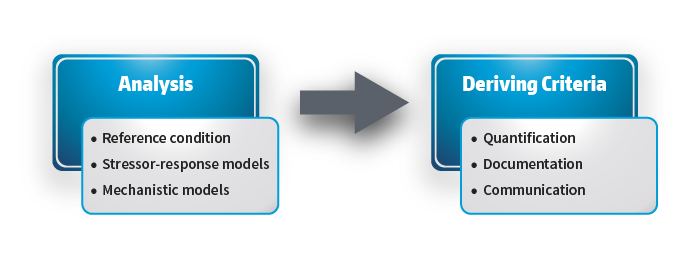
A diagram of the process of estimating nutrient conditions.
Figure 1. Conceptual diagram of the deliberative process for deriving NNC

Planning Sections

  • Quantifying and Documenting Protection of the Designated Use
  • Communicating Final Criteria

Next Section: Quantifying and Documenting Protection of the Designated Use

N-STEPS Online

  • Overview
  • Planning
    • Data Overview
    • Water Body Types
    • Management Goals
  • Problem Formulation
    • Assessment Endpoints
    • Conceptual Models
  • Analysis
    • Data Considerations
    • Select Approach
      • Reference Condition
      • Stressor-Response
      • Mechanistic Modeling
  • Criteria Derivation
    • Quantifying and Documenting Protection of the Designated Use
    • Communicating Final Criteria
  • Resource Library
    • References
    • Glossary and Additional Resources
    • Data Library
Contact Us About N-STEPS Online
Contact Us About N-STEPS Online to ask a question, provide feedback, or report a problem.
Last updated on April 13, 2026
  • Assistance
  • Spanish
  • Arabic
  • Chinese (simplified)
  • Chinese (traditional)
  • French
  • Haitian Creole
  • Korean
  • Portuguese
  • Russian
  • Tagalog
  • Vietnamese
United States Environmental Protection Agency

Discover.

  • Accessibility Statement
  • Budget & Performance
  • Contracting
  • EPA www Web Snapshot
  • Grants
  • No FEAR Act Data
  • Plain Writing
  • Privacy and Security Notice

Connect.

  • Data
  • Inspector General
  • Jobs
  • Newsroom
  • Regulations.gov
  • Subscribe
  • USA.gov
  • White House

Ask.

  • Contact EPA
  • EPA Disclaimers
  • Hotlines
  • FOIA Requests
  • Frequent Questions
  • Site Feedback

Follow.