


Moss Landing Air: What air monitoring activities did you do during the January 2025 fire response?
Return to: Frequently Asked Questions
- What air monitoring activities did you do during the January 2025 fire response?
- What particulate sizes did EPA monitor during the initial response in January, 2025?
- What did you test for during the fire?
- What were the results of EPA's air monitoring from January 17 to 20, 2025?
- Can you detect nanoparticles in the air with the instrumentation you used during the initial response?
- What happened with the spike in particulate matter at air monitoring station 9 the morning of January 18, 2025, which resulted in a 1.275 mg/m3 reading for PM10?
- What air monitoring technology did you use?
What air monitoring activities did you do during the January 2025 fire response?
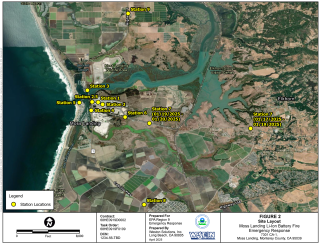
At the request of local agencies, EPA conducted perimeter and community air monitoring beginning the morning January 17.
- We had nine air monitors set up at and around the property.
- The monitors looked for mineral acid gases like hydrogen fluoride and particulates.
- After smoke subsided, EPA consulted with Monterey County and transferred air monitoring stations to Vistra to continue monitoring.
- We shared our air monitoring data with state and local officials.
- Please visit Monterey County’s “Moss Landing Vistra Battery Fire” dashboard for more information about their response to the fire.
EPA's air monitoring data was provided to local agencies for analysis to inform public health decisions.
For more information about community safety, see our Fact Sheet: Keeping the Community Safe (pdf) .
What particulate sizes did EPA monitor during the initial response in January, 2025?
EPA monitored for all of the particulate sizes listed below. If we say we are monitoring for PM2.5, this includes monitoring for particles 2.5 micrometers (μm) and smaller, down to the detection limit of the instrument (in this case 0.1 micrometers).
The equipment EPA used (see product specifics: TSI DustTrak) collected data for:
- PM1 (size fraction from 0.1 to 1 μm)
- PM2.5
- PM4
- PM10
- “Total Particulates”
PM2.5 is the smallest unit we regulate under the Clean Air Act. There is no federal air standard for less than PM2.5.
During the fires and since, regional air quality has been consistent with the air quality index (AQI) in the Monterey Bay and San Francisco Bay regions. The data shows air quality did not exceed the “moderate level” on the AQI for the Monterey area.
What did you test for during the fire?
We looked for contaminants likely found in a battery fire. The two main contaminants were: hydrogen fluoride and particulate matter.
What were the results of EPA's air monitoring from January 17 to 20, 2025?
- Particulate matter (PM2.5 and PM10)
EPA’s monitoring showed concentrations of particulate matter to be consistent with the air quality index throughout the Monterey Bay and San Francisco Bay regions, with no measurements exceeding the moderate air quality level. - Hydrogen fluoride gas
Hydrogen fluoride gas was measured at one second intervals and there were no exceedances of California’s human health standards.
Post-Fire
- The initial fire subsided on January 18, 2025.
- On January 20, after smoke subsided, EPA consulted with Monterey County and transferred air monitoring stations to Vistra.
- Vistra continued air monitoring at the property and in the community. The data is being provided to the county.
Can you detect nanoparticles in the air with the instrumentation you used during the initial response?
The term “nanoparticle” is often used to describe small particulate matter. The TSI DustTrak instruments used for air monitoring detect particles sized 0.1 microns (0.1 microns is the same as 100 nanometers) and larger. For reference, human hair is approximately 50-70 microns in thickness. (See EPA’s webpage on Particulate Matter for more information.)
We expect metal particulates that may be associated with the fire to be detectable by the air monitoring instruments.
What happened with the spike in particulate matter at air monitoring station 9 the morning of January 18, 2025, which resulted in a 1.275 mg/m3 reading for PM10?
EPA contractors were servicing the equipment at station 9, which resulted in a false reading of a temporary spike in PM10 at that location.
Some temporary spikes or gaps in the data are expected, due to various factors such as lapses in telemetry (data transmission), instrument batteries dying (because of running 24/7 operations in the field remotely), and routine maintenance. For example, if the transmission of data to the database is not paused during equipment servicing, it can result in false elevated readings.
EPA investigated this particular elevated reading and then reviewed the equipment service logs from EPA contractors. EPA determined the data does not indicate sustained elevated readings of particulate matter (PM) 10, and that the equipment was being serviced at this time. EPA looks for sustained patterns of elevated readings to assess air quality impacts. There is sufficient data to show that particulate matter concentrations from the fire were not exceeding human health standards.
What air monitoring technology did you use?
To monitor particulate matter, we used TSI DustTrak Monitors. We used the Honeywell SPM Flex (with the mineral acid chemistry cassette) to monitor for hydrogen fluoride.