U.S. flag

An official website of the United States government

Here’s how you know

Dot gov

Official websites use .gov
A .gov website belongs to an official government organization in the United States.

HTTPS

Secure .gov websites use HTTPS
A lock (LockA locked padlock) or https:// means you’ve safely connected to the .gov website. Share sensitive information only on official, secure websites.

    • Environmental Topics
    • Air
    • Bed Bugs
    • Chemicals, Toxics, and Pesticide
    • Emergency Response
    • Environmental Information by Location
    • Health
    • Land, Waste, and Cleanup
    • Lead
    • Mold
    • Radon
    • Research
    • Science Topics
    • Water Topics
    • A-Z Topic Index
    • Laws & Regulations
    • By Business Sector
    • By Topic
    • Compliance
    • Enforcement
    • Guidance
    • Laws and Executive Orders
    • Regulations
    • Report a Violation
    • Environmental Violations
    • Fraud, Waste or Abuse
    • About EPA
    • Our Mission and What We Do
    • Headquarters Offices
    • Regional Offices
    • Labs and Research Centers
    • Planning, Budget, and Results
    • Organization Chart
    • EPA History

Breadcrumb

  1. Home
  2. N-STEPS Online
  3. Analysis
  4. Select Approach
  5. Stressor-Response

Stressor-Response: Classification

Stressor-Response Sections

Overview   |   Data Preparation  |  Classification   |   Computation

Step 4: Classify Water Bodies into Groups

To classify water bodies for stressor-response analysis, you identify groups of water bodies that have similar stressor-response relationships. Relationships estimated within the groups can be more accurate and precise than relationships estimated using the full data set. Classifying water bodies into distinct groups also provides the means to control for the effects of other variables (i.e., candidate classification variables) on the stressor-response relationship of interest while still allowing for relatively simple models that simulate the response as a function of stressor levels. For example, the coplot of hypoxic extent versus chlorophyll a concentration indicates that the stratification status of a lake strongly influences the slope of the relationships between chlorophyll a and hypoxic extent. This finding suggests that lakes should be classified by stratification status prior to stressor-response modeling. In this case, classification controls for the effect of the stratification and improves the precision of the resulting stressor-response relationships (see Figure 4).
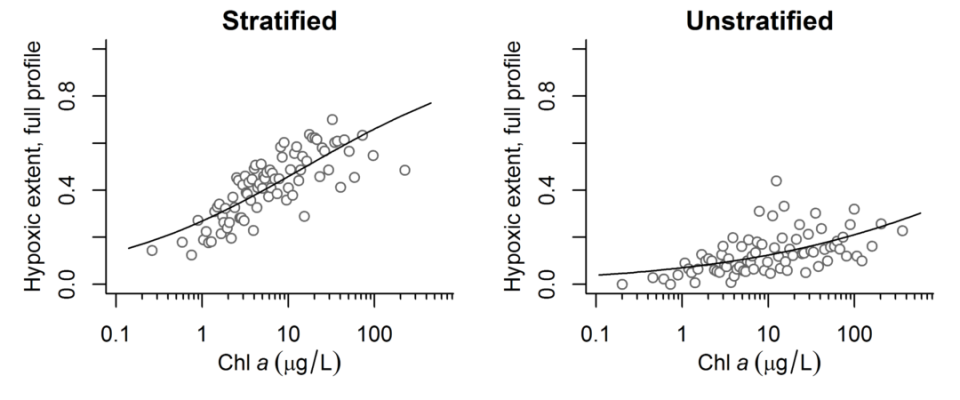
Figure 4. Classifying lakes by the strength of stratification reveals a strong relationship between hypoxic extent and chlorophyll a in stratified lakes. The same relationship is much weaker in unstratified lakes.

Statistical approaches are available to automatically screen a large number of variables and identify a combination of classification variables that maximizes the precision of the stressor-response relationship of interest (e.g., TREED regression) (Yuan and Pollard 2014, Yuan and Pollard 2015a).


Next Section: Calculation

N-STEPS Online

  • Overview
  • Planning
    • Data Overview
    • Water Body Types
    • Management Goals
  • Problem Formulation
    • Assessment Endpoints
    • Conceptual Models
  • Analysis
    • Data Considerations
    • Select Approach
      • Reference Condition
      • Stressor-Response
      • Mechanistic Modeling
  • Criteria Derivation
    • Quantifying and Documenting Protection of the Designated Use
    • Communicating Final Criteria
  • Resource Library
    • References
    • Glossary and Additional Resources
    • Data Library
Contact Us About N-STEPS Online
Contact Us About N-STEPS Online to ask a question, provide feedback, or report a problem.
Last updated on April 13, 2026
  • Assistance
  • Spanish
  • Arabic
  • Chinese (simplified)
  • Chinese (traditional)
  • French
  • Haitian Creole
  • Korean
  • Portuguese
  • Russian
  • Tagalog
  • Vietnamese
United States Environmental Protection Agency

Discover.

  • Accessibility Statement
  • Budget & Performance
  • Contracting
  • EPA www Web Snapshot
  • Grants
  • No FEAR Act Data
  • Plain Writing
  • Privacy and Security Notice

Connect.

  • Data
  • Inspector General
  • Jobs
  • Newsroom
  • Regulations.gov
  • Subscribe
  • USA.gov
  • White House

Ask.

  • Contact EPA
  • EPA Disclaimers
  • Hotlines
  • FOIA Requests
  • Frequent Questions
  • Site Feedback

Follow.