U.S. flag

An official website of the United States government

Here’s how you know

Dot gov

Official websites use .gov
A .gov website belongs to an official government organization in the United States.

HTTPS

Secure .gov websites use HTTPS
A lock (LockA locked padlock) or https:// means you’ve safely connected to the .gov website. Share sensitive information only on official, secure websites.

    • Environmental Topics
    • Air
    • Bed Bugs
    • Chemicals, Toxics, and Pesticide
    • Emergency Response
    • Environmental Information by Location
    • Health
    • Land, Waste, and Cleanup
    • Lead
    • Mold
    • Radon
    • Research
    • Science Topics
    • Water Topics
    • A-Z Topic Index
    • Laws & Regulations
    • By Business Sector
    • By Topic
    • Compliance
    • Enforcement
    • Guidance
    • Laws and Executive Orders
    • Regulations
    • Report a Violation
    • Environmental Violations
    • Fraud, Waste or Abuse
    • About EPA
    • Our Mission and What We Do
    • Headquarters Offices
    • Regional Offices
    • Labs and Research Centers
    • Planning, Budget, and Results
    • Organization Chart
    • EPA History

Breadcrumb

  1. Home
  2. Indoor Air Quality (IAQ)

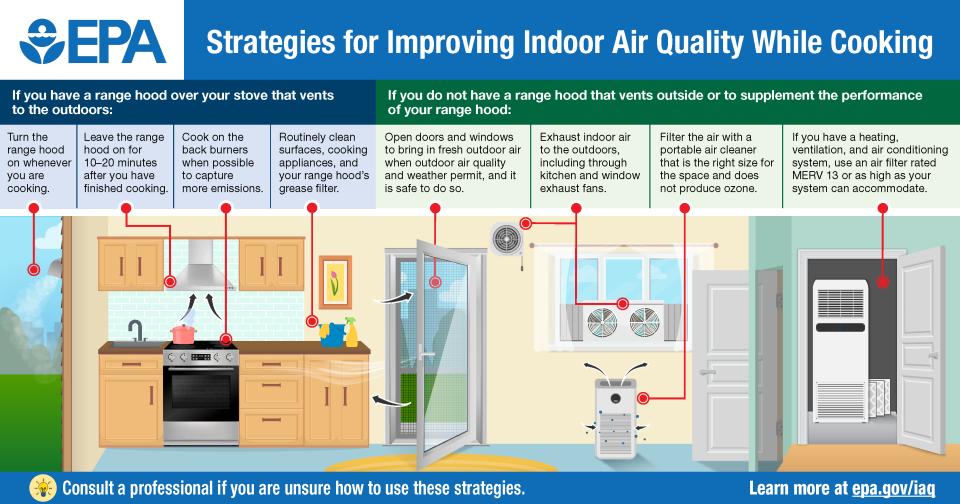
Strategies for Improving Indoor Air Quality While Cooking Infographic

This infographic describes best practices for improving indoor air quality while cooking. 

  • Download the infographic:  Strategies for Improving Indoor Air Quality While Cooking (pdf) (16.13 MB)
  • Text version of the infographic

An infographic depicting Strategies for Improving Indoor Air Quality While Cooking

Text Version of the Infographic

Strategies for Improving Indoor Air Quality While Cooking

If you have a range hood over your stove that vents to the outdoors:

  • Turn the range hood on whenever you are cooking.
  • Leave the range hood on for 10–20 minutes after you have finished cooking. 
  • Cook on the back burners when possible to capture more emissions. 
  • Routinely clean surfaces, cooking appliances, and your range hood’s grease filter.

If you do not have a range hood that vents outside or to supplement the performance of your range hood:

  • Open doors and windows to bring in fresh outdoor air when outdoor air quality and weather permit, and it is safe to do so. 
  • Exhaust indoor air to the outdoors, including through kitchen and window exhaust fans. 
  • Filter the air with a portable air cleaner that is the right size for the space and does not produce ozone. 
  • If you have a heating, ventilation, and air conditioning system, use an air filter rated MERV 13 or as high as your system can accommodate.             

Note: Consult a professional if you are unsure how to use these strategies.


Indoor Air Quality (IAQ)

  • Learn about Indoor Air Quality
  • IAQ by Building Type
  • Indoor Air Pollutants and Sources
  • IAQ Science and Technologies
  • Networking and Funding
  • Webinars, Meetings and Resources
  • IAQ Trending Topics
  • IAQ Frequently Asked Questions
  • Publications about IAQ
  • Regional and State IAQ Information
Contact Us about Indoor Air Quality
Contact Us about Indoor Air Quality to ask a question, provide feedback, or report a problem.
Last updated on March 10, 2026
  • Assistance
  • Spanish
  • Arabic
  • Chinese (simplified)
  • Chinese (traditional)
  • French
  • Haitian Creole
  • Korean
  • Portuguese
  • Russian
  • Tagalog
  • Vietnamese
United States Environmental Protection Agency

Discover.

  • Accessibility Statement
  • Budget & Performance
  • Contracting
  • EPA www Web Snapshot
  • Grants
  • No FEAR Act Data
  • Plain Writing
  • Privacy and Security Notice

Connect.

  • Data
  • Inspector General
  • Jobs
  • Newsroom
  • Regulations.gov
  • Subscribe
  • USA.gov
  • White House

Ask.

  • Contact EPA
  • EPA Disclaimers
  • Hotlines
  • FOIA Requests
  • Frequent Questions
  • Site Feedback

Follow.